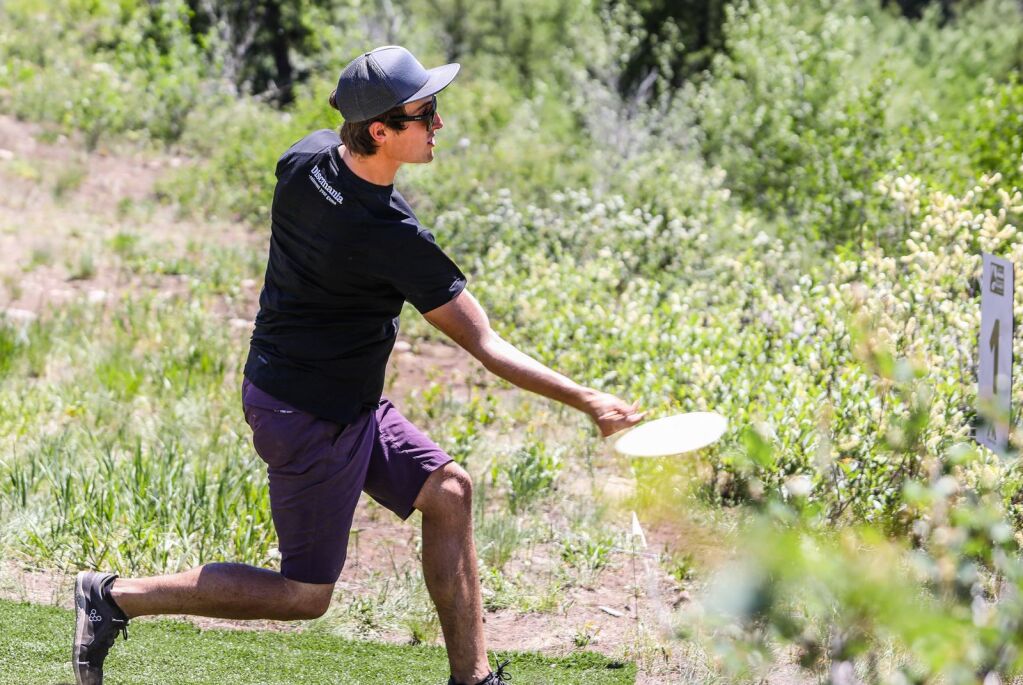
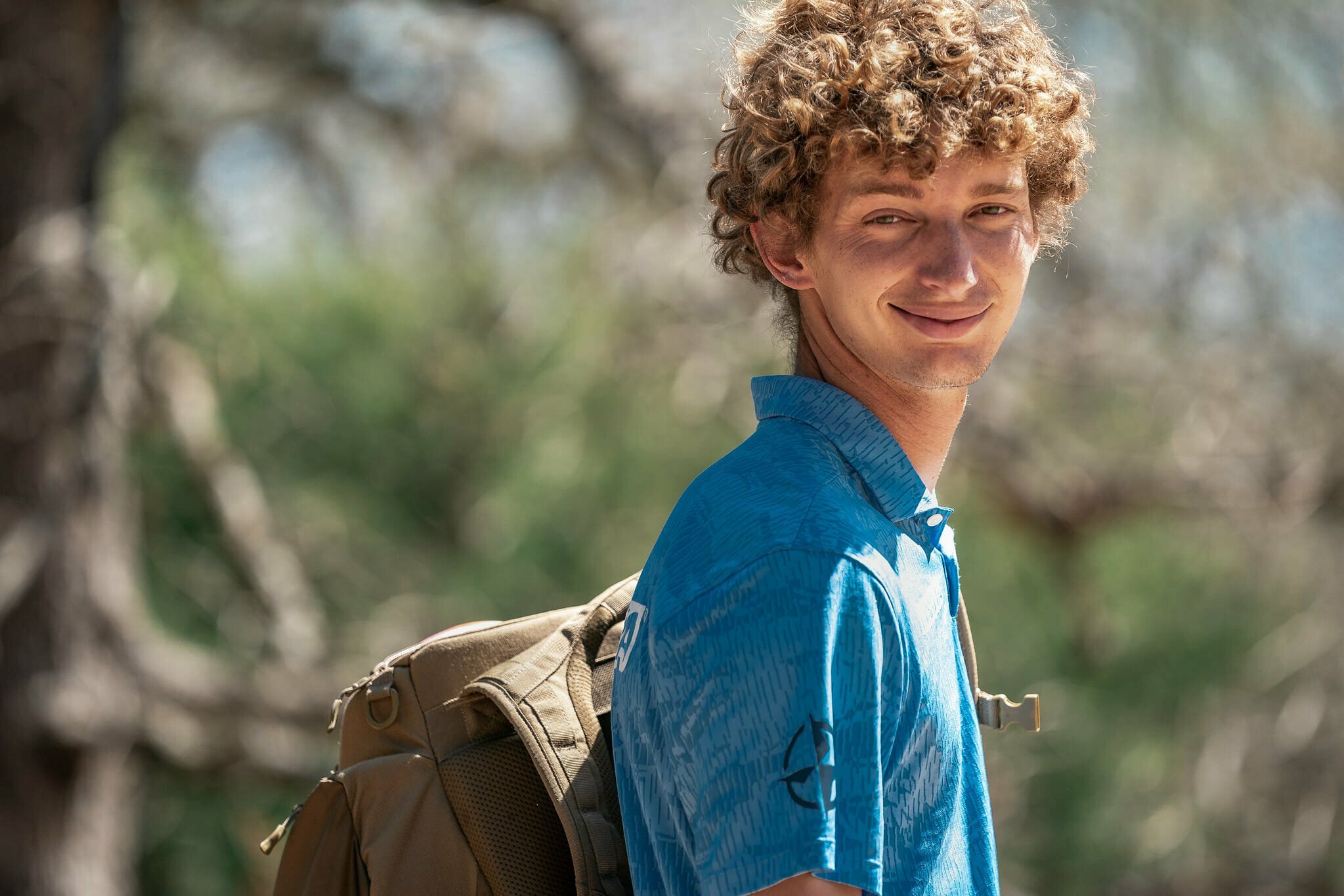
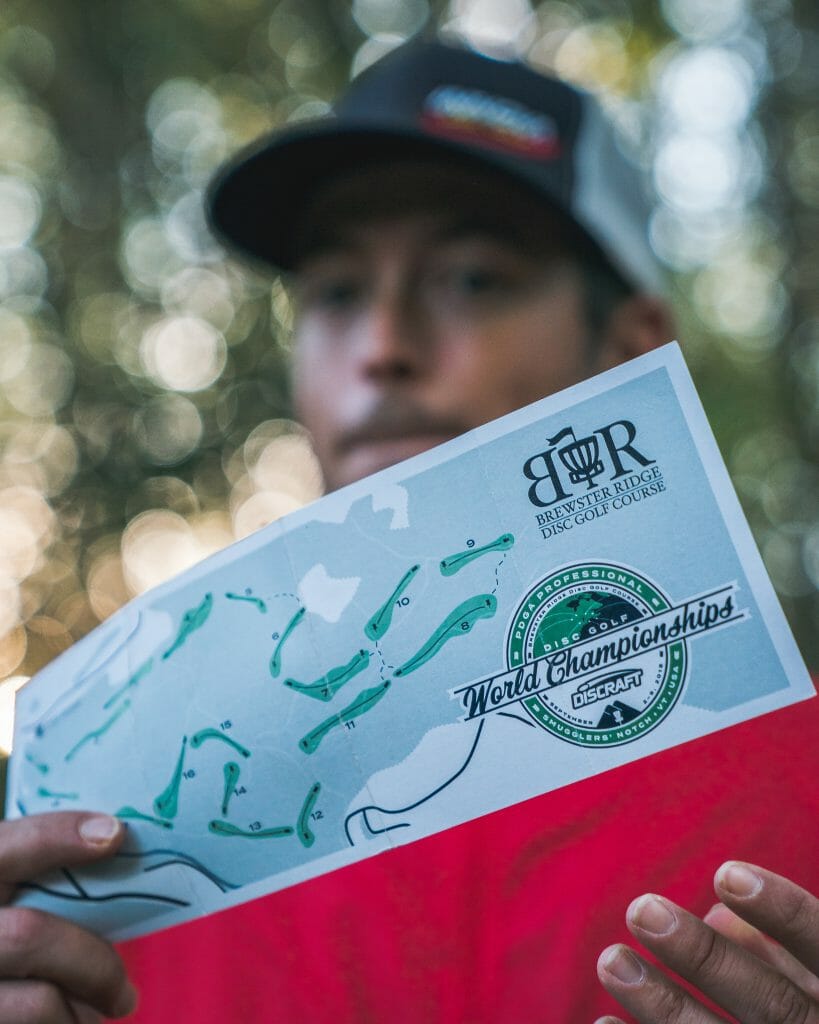
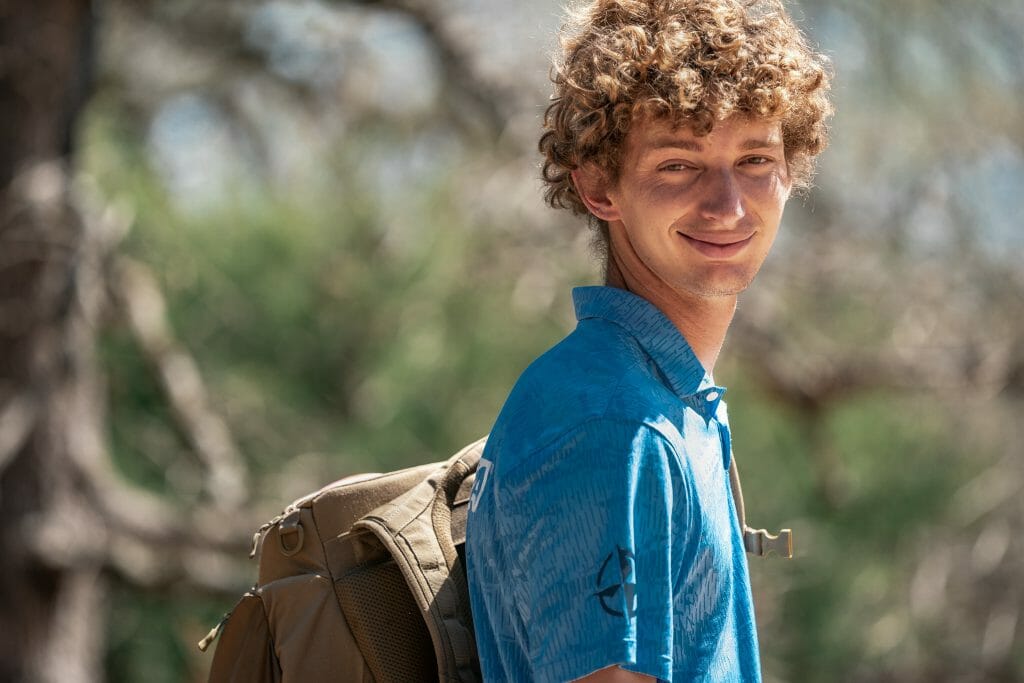
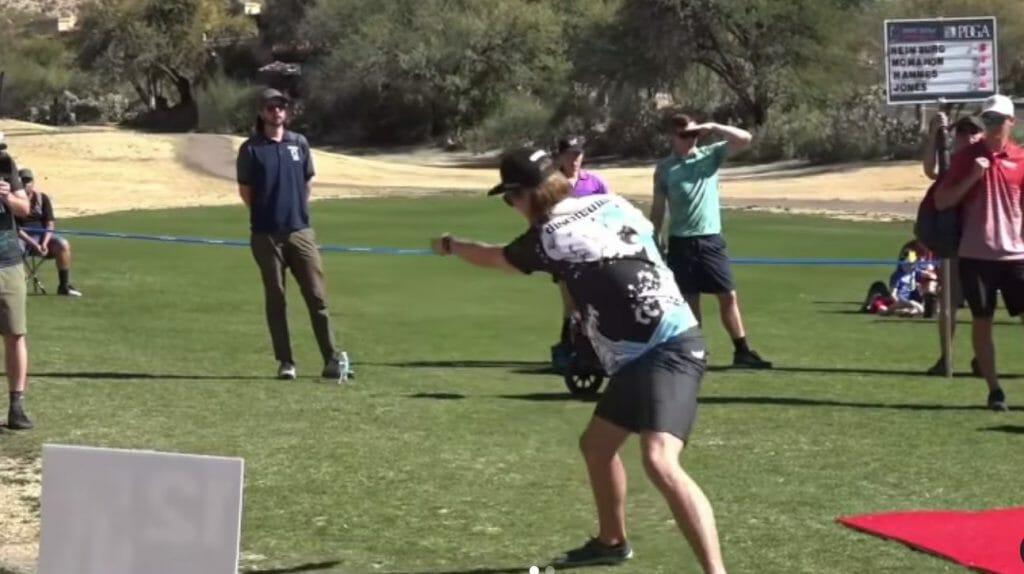
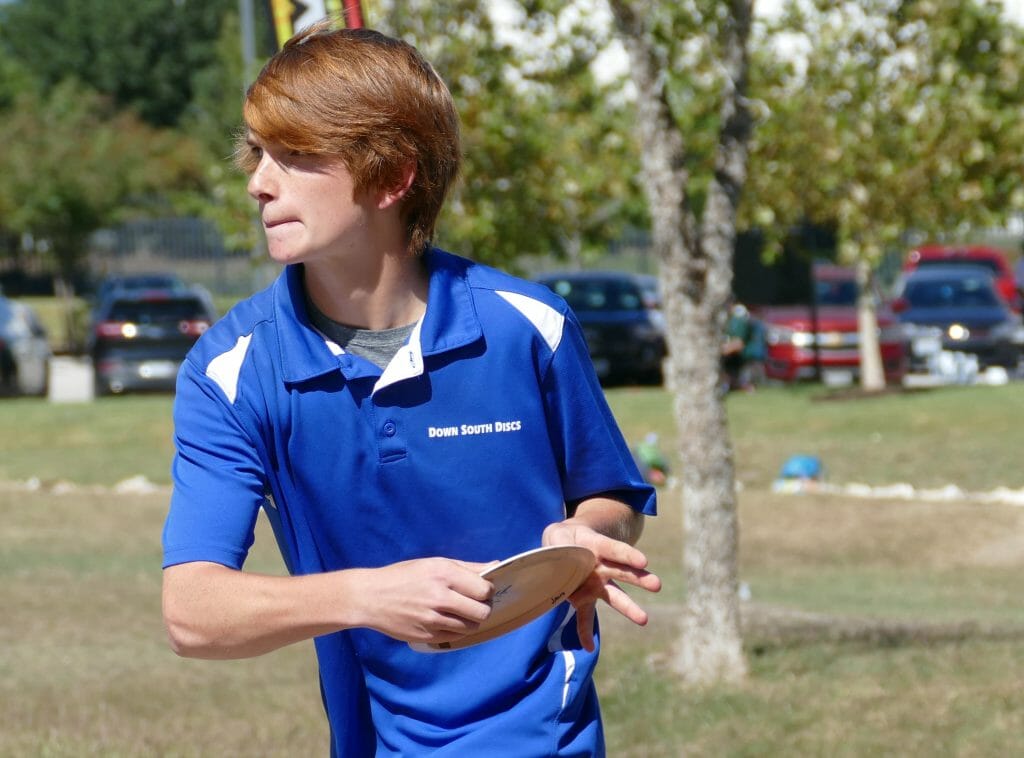
Eagle McMahon tees off on the first hole of the GoPro Mountain Games Disc Golf Tournament Sunday at Maloit Park in Minturn. McMahon is one of the top ranked disc golfers in the world.
Eagle McMahon visited the Vail area in 2015 and 2016, playing in tournaments organized by the Eagle County-based Flying Eagle Disc Society.
Since then, the Boulder resident has went on to win some of the most competitive events in the sport, playing disc golf in Europe, Australia and “pretty much every state in the U.S.,” he told the Vail Daily on Sunday.
Walking the course at Maloit Park in Minturn, McMahon said he was happy to be back.
“It was actually a deal maker for me that this was not (Professional Disc Golf Association) sanctioned, because I just wanted to come up here, play in the mountains, have some fun and just tone it down for a while,” McMahon said.
Women’s winner Erikah Weir said this year’s GoPro Mountain Games was a hot-ticket event on the disc golf calendar.
“It was a race to know when the registration is going to happen,” Weir said. “Disc golf is one of those sports that really exploded during the pandemic, so we’ve seen a tremendous amount of growth.”
Steve Klehfoth with the Flying Eagle Disc Society said that the 2021 GoPro Mountain Games tournament sold out in less than 48 hours.
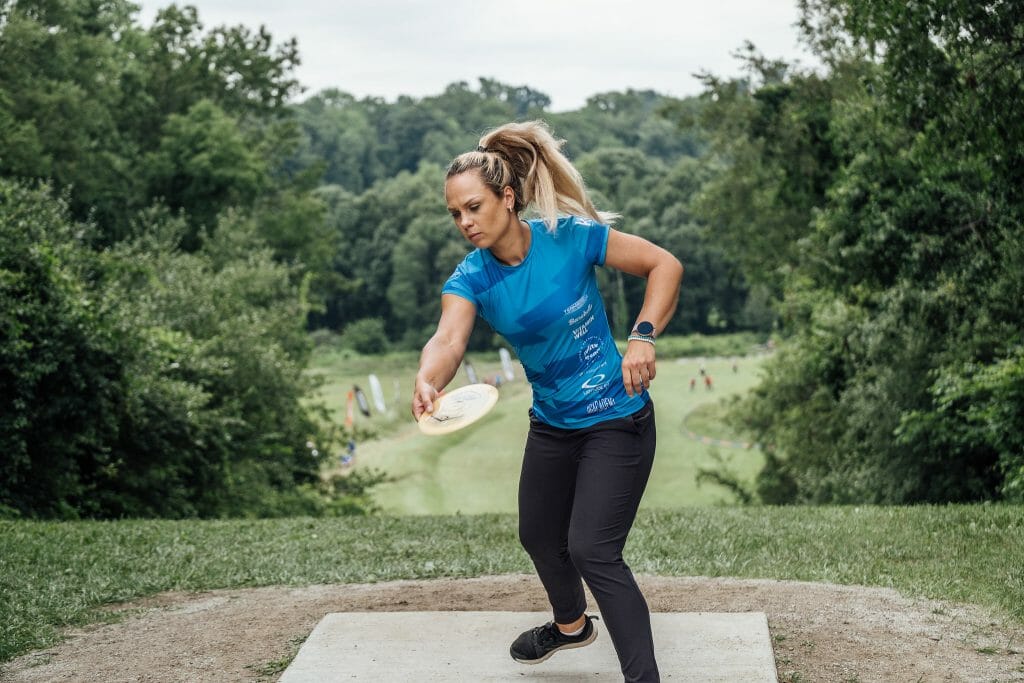
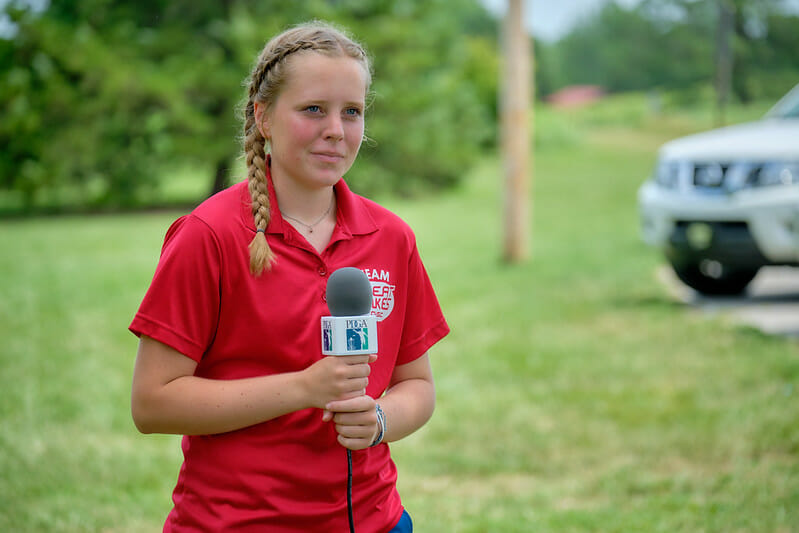
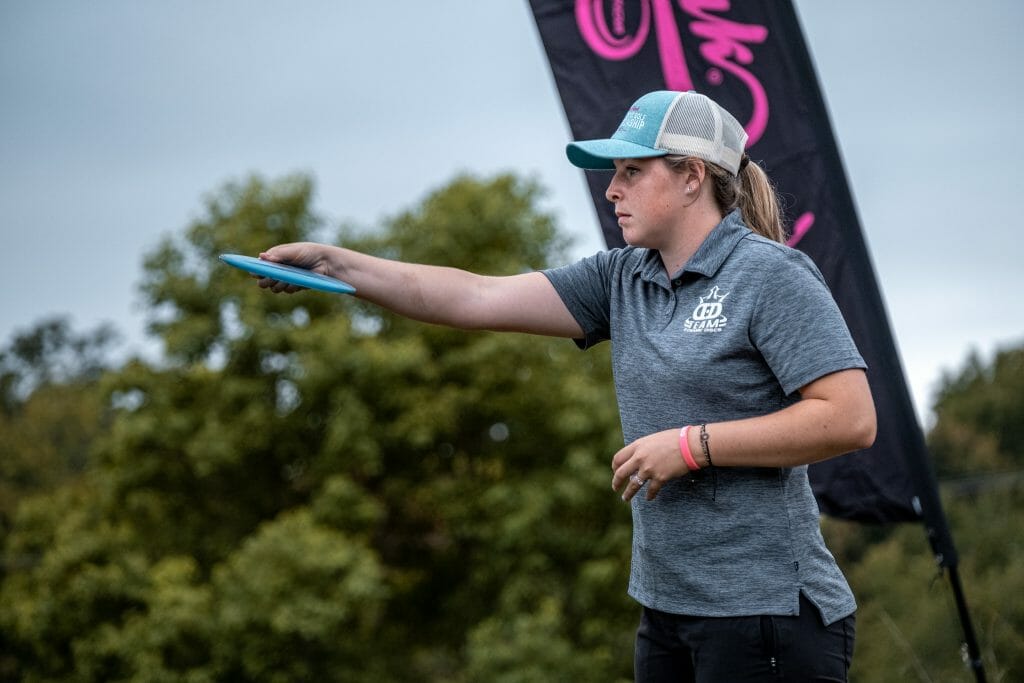
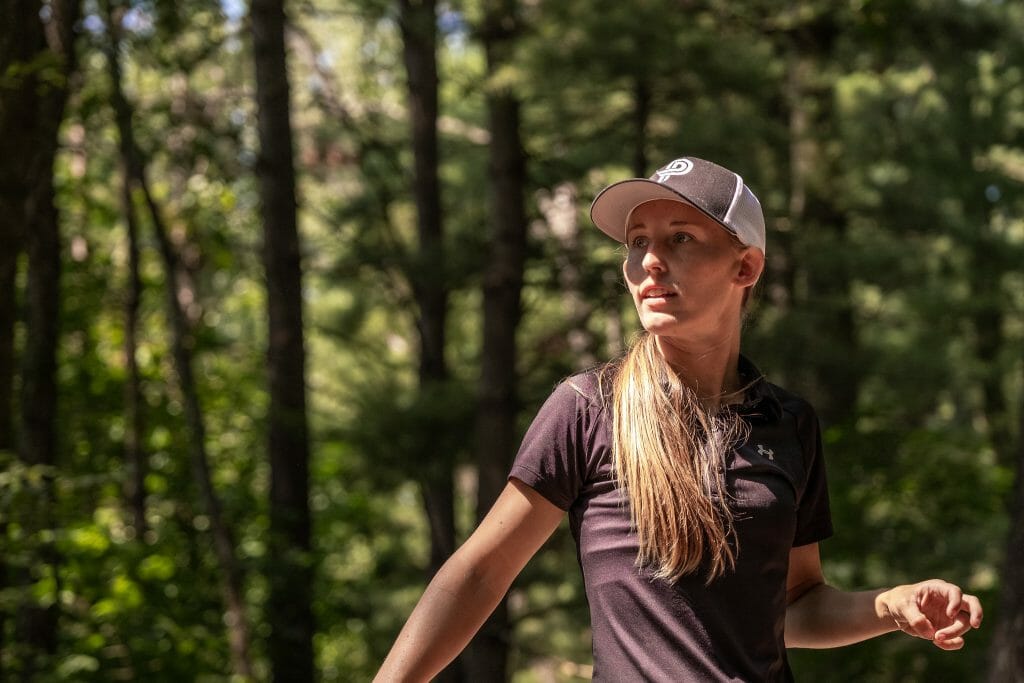
Eirkah Wier prepares to tee off on the second hole of the GoPro Mountain Games Disc Golf Tournament Sunday in Maloit Park in Minturn.
Stopover before worlds
McMahon is on his way to Utah to compete in the 2021 PDGA Professional Disc Golf World Championships in Ogden starting June 22. He said the GoPro Mountain Games presented a perfect stopover opportunity for him.
“I’m friends with Steve Klehfoth and I saw they had this event, and I wasn’t really doing anything on the weekend anyway, so I figured perfect little stop before heading out to worlds, have some fun out here and decompress,“ McMahon said. ”The statistics (at the GoPro Mountain Games) don’t count for your overall career stats, which, it’s a good thing that we record stats, but sometimes you just kind of want to be off the record, take a deep breath and have some fun.”
McMahon was first drawn to Flying Eagle Disc Society disc golf tournaments in 2015 when he learned that the club’s annual event would be taking place on a traditional golf course or, as disc golfers call it, a “ball golf“ course.
“It was definitely cool to be playing disc golf on a ball golf course in the mountains at the time,” McMahon said. “That was the time when you weren’t seeing as many ball golf courses. But ever since then, it’s become a very normal idea, and you see if all over the country.”
Professional disc golf
With disc golf exploding in popularity, it has allowed the idea of the disc golf professional to become a reality. But that also brings the pressures of the task at hand.
“Disc golf is my job, but I got into it as a hobby, and it’s my passion,” McMahon said Sunday. “So (at the GoPro Mountain Games) I can bring it back to my roots, not worrying about it, and just playing for the love of the game. That’s kind of what brought me here.”
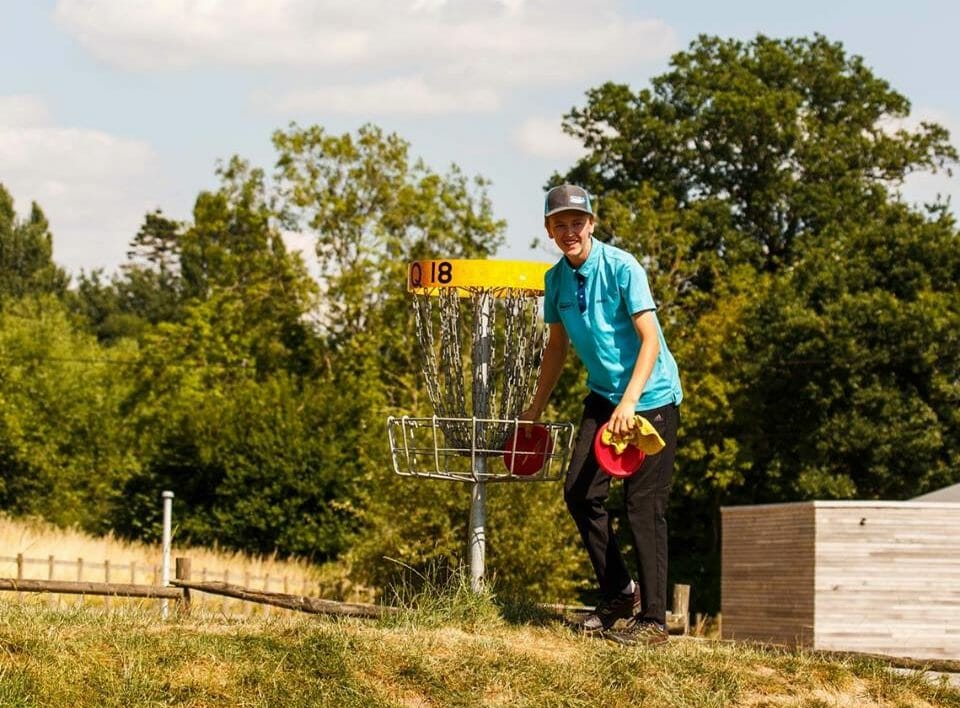
Local Nathan Matlack tees off during the GoPro Mountain Games Disc Golf Tournament Sunday in Minturn.
The emergence of the professional disc golfer has also brought fans. The top finishing local on the day, Nathan Matlack of Edwards, got to join McMahon’s foursome on Sunday after shooting the low round on Saturday.
“It was surreal to watch Eagle on Jomez coverage, at a huge event last weekend, and just geek out like a fan, and then be watching him sink 90 footers in my face, live, the next weekend,” Matlack said.
Matlack was able to ask McMahon questions about disc golf and specific tournament moments he has watched via streaming services in recent years.
“It was really cool to chat with him in person,” Matlack said.
Matlack finished tied for 5th in the open division, taking home $215 for the effort.
February 23, 2022 by Charlie Eisenhood, Patrick Aubyrn, Kingsley Flett, Gabe LaBounty, Jesse Weisz, Cameron Guidry, Christopher Wiklund, Steve Andrews and Ben Murphy in Preview with comments
The 2022 disc golf season is finally here! The top professional players are warming up in the Nevada sunshine as the Las Vegas Challenge, the first stop on the 2022 Disc Golf Pro Tour, kicks off the touring season tomorrow.
Inside, we look at the stories that will define the next nine months!
PDGA/DGPT Unification: Tour Cards, Playoffs, and Media, Oh My!
In some ways, it’s remarkable how quickly the Disc Golf Pro Tour has gone from a shaky foundation to being the only game in town, with all the North American players and even top European athletes planning their seasons around it.
In the offseason, the PDGA ceded control of the professional side of the game to the DGPT, folding the long-standing National Tour into a single, unified Disc Golf Pro Tour. And the professionalization has been happening fast. Top players from 2021 (plus some European and other exemptions) get a slew of benefits as a Tour Card holder. The Pro Tour sold its media rights to post-production teams for hundreds of thousands of dollars. Minimum added cash is going ever higher.
And the season structure is getting more clearly defined as well. Now, Majors earn players DGPT points, too, and everything funnels into a multi-tournament playoff structure that whittles the field down from 150 at Green Mountain Championships to 96 at the MVP Open to 48 at the DGPT Championship, a model loosely modeled around the PGA Tour’s FedEx Cup.
The DGPT is borrowing another concept from other professional sports: the play-in tournament. Major League Baseball recently added a Wild Card play-in game; the NBA also introduced two 4-team play-in tournaments to set its 16-team bracket last year. This year, the DGPT will offer six players in both MPO and FPO the chance to earn the final two spots in the Tour Championship: the next two players in the standings, then any players that won an Elite Series event or Major but didn’t directly qualify for the Tour Championship, and then any additional slots allocated to the next players in the standings.
All together, it stands as an inflection point in pro disc golf history, a changing power balance and new focus at the elite end of the sport.
– Charlie Eisenhood
Is this the Year of the Dark Horse?
Gregg Barsby holds a scorecard during 2018 Pro Worlds. Photo: Alyssa Van Lanen – PDGA
I first met Gregg Barsby in the car park at Delaveaga prior to the Pro Worlds in 2011. He approached me while I was flipping through racks of discs at the fly-mart and said, “hey man, I’ve got a few discs in the car to sell, they’ll be cheaper.” I followed the future world champ back to a little wagon-style car with its best years well behind it, by a decade or more. In the back was a jumble of clothes, a sleeping bag, and boxes of discs. Barsby’s tour included 31 tournaments that year. He would finish 16th that week in Santa Cruz and earn $575 in prize money on his way to $11,923 for the year. The few discs he sold me and anyone else would have supplemented that prize money, but I had to assume that he attended those 31 tournaments through a combination of sleeping in that car, couch surfing, and the kindness of strangers. If you talk with any pro about touring in those years, they make it sound like a lot of fun. But it’s not an ideal environment for peak athletic performance.
In the past half decade, the sport’s top players have begun to leave that lifestyle behind. Some travel with managers, they either fly-in and out of events, staying in quality accommodation, or travel in mobile homes that would make any van-life YouTuber envious. There are still a few zeros less in their paychecks than those of tennis players or golfers, but, in recent times, our handful of top performers have had a similar touring lifestyle to other pro athletes. This year, they will be joined by quite a few more.
As the increase in prize purses and sponsorship money trickles down to the second and third tiers of the sport, many other disc golfers are leaving the ramen noodles, Walmart carparks, and austere lifestyle behind to embrace a level of preparation that matches the very best in the game. Even a one percent improvement is the difference between being on the podium and not over a 72-hole tournament. I sense that the tide is rising right across the sport.
I wonder which players, then, will take the opportunity and become 2022’s dark horse? It might be Bradley Williams, who has been working hard in his offseason, especially on his putting stroke. Or will Ezra Aderhold break though? Maybe Missy Gannon will build on her stunning win in the DGPT Championship and carry that form through 2022? Or what about Gannon’s podium mate from that tournament Nathan Queen, who spent some of his winnings on some rolling tour hardware. Matt Orum will be touring full time this year (though he’s currently out for this weekend after getting his appendix removed). Has Madison Walker put her injuries behind her? Maybe Holly Finley will continue her relentless drive to the top?
What about the Europeans? Will Linus Carlsson or Eveliina Salonen show us that the game over there has grown in isolation and leapfrogged the US?
This list could go on, but the odds are that 2022’s dark horse won’t be on it. Gregg Barsby himself was a dark horse in 2018 when he won the World Championships. That’s the thing about dark horses: they always surprise you.
– Kingsley Flett
The Europeans Are Back
Kristin Tattar at the 2021 Great Lakes Open. Photo: DGPT
No need for a blurb here when we’ve got an entire series about the return of European disc golf to the world stage. Things get off to quite the start with the FPO feature card in round one of Las Vegas Challenge tomorrow: the top four highest-rated women in the world — Paige Pierce, Kristin Tattar, Eveliina Salonen, and Henna Blomross — will tee off on the same card. It’s the highest-rated FPO card in disc golf history. Really.
– Charlie Eisenhood
Power Players
Unfettered, infinite, and totally ethical growth is what capitalism is all about, but what is disc golf capitalism all about?
In recent years, we have seen a transition occur in the power dynamics between players and their manufacturers. Before 2019 or so, manufacturers were clearly in the driver’s seat when it came to the business side of the game. Players simply couldn’t support themselves on tour without their manufacturer sponsors who provided a stipend, gas money, plastic, and winnings bonuses. There were only a handful of companies involved in professional disc golf, and because of this, they dominated a relatively small market and could dictate the terms of their support without much consequence.
That has changed dramatically. At least at the top levels of the game, players are more valuable to a manufacturing company than the other way around. If the Luna was released as a regular putter in the existing Discraft lineup, would it have been as much of a cash cow? Probably not. Slap McBeth branding on it, and you have a major hit. MVP discs had a cult following but not a huge share of the market or conversation, then James Conrad makes The Shot and they sell more plastic in a couple days than they had over the course of the entire previous year. The PDGA tried to set up a new major with a new format, then the players complained and the PDGA backtracked and capitulated to the players’ demand for a more traditional format.
It seems right now that disc golf capitalism is perhaps a little more Marxian than we realized, where labor (the players) are indeed entitled to and obtaining the fruits of their labor. Fans will spend money on discs and merch, not because they necessarily need the product itself, but because they want to support their favorite player. Whether the plastic is molded in Michigan or California doesn’t really matter to many, but supporting an individual player does matter to fans.
Players and companies who have understood the paradigm shift have been the most successful over the past couple of years, Discraft is the perfect example. In their ads we see Brodie Smith, Paul McBeth, and Paige Pierce in the warehouse, with nary a mention of the actual product. They have been extremely successful in recent years. Innova has let players walk rather than pay them, and their advertising tends to be very product forward. Could they see some sales slippage?
In 2022, there will be new discs released, new merch to buy, new gizmos and gadgets to stuff your bag with, and you will purchase it not because it’s a DD product or a Prodigy doodad. You’ll buy it because you want to support Kona Panis and you like Kevin Jones.
– Chris Wiklund
#ContractYearCalvin
Calvin Heimburg. Photo: DGPT
Let’s take a look at the top five rated players in the world: Ricky Wysocki, Eagle McMahon, Paul McBeth, Calvin Heimburg, and Chris Dickerson.
Paul got paid. Ricky got paid. We don’t know how much Eagle gets paid, but he’s definitely getting paid. Chris Dickerson just bounced from Prodigy so that he can get paid (a Buzzzworthy offseason, no doubt). Further down the ratings leaderboard, Kevin Jones got paid.
Now it’s Calvin’s turn to get paid. Heading into the final season of his current contract with Innova, he’s surely doing just fine for himself, but, if he has a great season, he is going to have some serious suitors in the 2022 offseason. He knows this. The effort going into his social media has picked up quite a bit in recent months, and his game looks sharp: he was the standout player at the All-Star Weekend two weeks ago, showing off his powerful distance in the skills challenge and then finishing first (and beating Eagle) in the singles round.
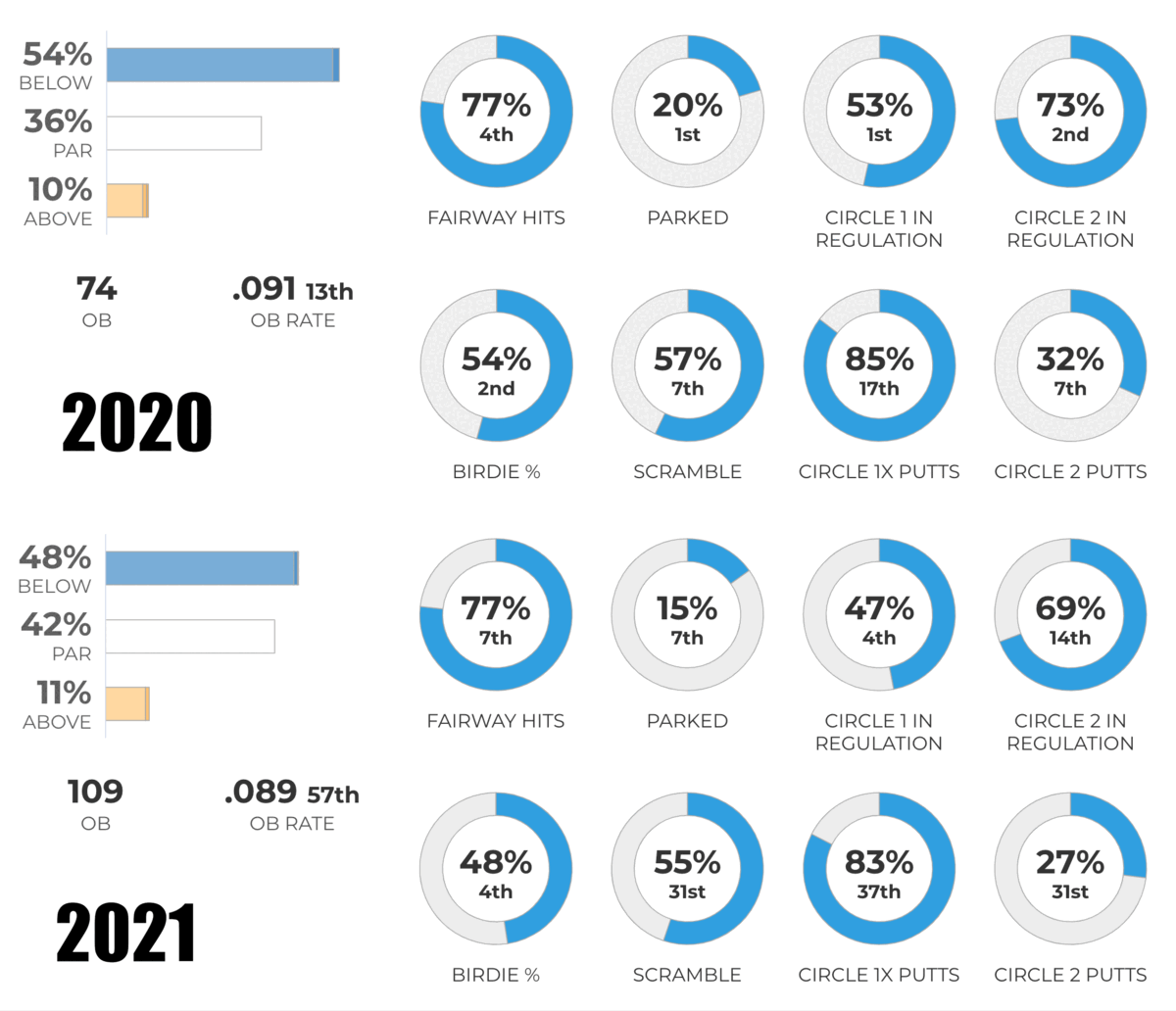
He’s been one of the best players on tour for two years now, but his 2021 performance was a bit down compared to 2020. Take a look at his stats from the last two years:
There’s the obvious caveat that there were a lot more tournaments on a lot more course in 2021 than in 2020, but you can still see the slight percentage reduction in performance across categories (and relative rankings).
Could a contract year be just the ticket to push Calvin to new highs? You could hardly ask for more motivation heading into a season.
– Charlie Eisenhood
FPO Players to Watch
Stacie Hass at 2021 Junior Worlds. Photo: Kevin Huver — PDGA.
We spend a lot of time evaluating which players in the bottom half of the top 25 will elevate their status and challenge the stalwarts in the top 10. I want to highlight a few players I’m watching to break into the top 25 in 2022.
Let’s start with Holyn Handley and Stacie Hass, the latter my way-too-early frontrunner for DGPT Rookie of the Year Handley would be on my shortlist, too, but she is ineligible after playing four Elite Series/Majors in 2021. Hass was runner-up at Junior Worlds in 2021, and has since raised her rating 27 points to 912. Roll back the tape on the 2021 CCR Open—the kid can bomb. She also converted 76% of her C1X putts in her six UDisc rounds last year. Both are planning extensive U.S. tours.
I’m also keeping an eye on Leah Tsinajinnie. 2022 will be her second full season on tour. It would not surprise me to see her break into the 900-club before the Champions Cup. The ultimate frisbee convert finished 30th in DGPT points and 25th in PDGA NT points last year. Norwegian Lykke Lorentzen plans to visit the states several times this year in addition to playing on the European circuit. Lorentzen was my pick for Breakout Player of the Year in 2020 before the pandemic shut down international travel. Her work ethic is strong, and she spends just as much time in the gym as she does in the field.
Finally, Estonian Keiti Tätte will make her stateside debut this year (though she won’t debut at LVC as planned due to illness). She’ll be in good company, touring with Kristin Tattar and Silver Lätt. If somehow you haven’t seen her long throw-in for birdie at the European Disc Golf Championship, do yourself a favor and check it out. Based on her 937 rating, she is tied for 25th best in the world with Juliana Korver, Ella Hansen, and Alex Benson.
– Patrick Aubyrn
Brodie v. Stokely
Photo: Brodie Smith
Last year in our season preview, I set the over/under line for Brodie Smith’s ratings increase at 1015. He started the 2021 season at 999. He was able to eclipse that number and finished 2021 with a 1017 player rating, where he currently sits to start the 2022 season.
I believe Brodie is still at a point where fans consider him a new player and new to the tour. He was determined to not just be another celebrity or athlete that plays disc golf but to be thought of as a professional disc golfer and that alone. The transition took time but seems to have come to fruition.
As Brodie starts his third year on tour, a veteran of the sport, Scott Stokely, starts his very first year on the Disc Golf Pro Tour. Stokely has been playing in the Men’s Open division longer than Brodie has been alive but has not played in anything higher than a B-Tier in the open division since 2016. He was once rated in the 1020s with his all-time high at 1023.
Stokley is currently rated 992, and he has been in that general neighborhood for most of the last 15 years, with a few peaks around 1010. He has not been rated as high as Brodie is now since the year 2000.
So the question. Who will have a greater ratings jump in 2022: Brodie Smith or Scott Stokely? Secondary questions would be who will have the higher average finish at shared events? And who will have the highest single finish out of all the events they both play?
Scott Stokely
They are both currently signed up to play 11+ events with six in common, both starting in Vegas with the season opener this weekend. I’m sure more will be added for both players as further phases of the DGPT open up.
If I was setting over /unders for each player I would say:
Brodie Smith: 1025
Scott Stokely: 1010
My thinking is that it should be much easier (and faster) for Stokley to bump his rating higher with a 992 starting point, and Brodie is just now reaching that 1020 log jam of players. Getting to that 1025+ region is a different tier in the sport.
Perhaps the question on even more people’s minds: who will win more skins? Both Brodie and Stokely will be playing in the big money skins match at Eagle’s Crossing in April, with at least $11,800 on the line. They’re going up against Calvin Heimburg and Eagle McMahon. Maybe the question is whether they will win any skins at all.
– Darren LeMay
Load Management
The idea of “load management” was popularized by the NBA in the last few years as teams and players started to change how they prioritize the grind of the regular season against the possibility of being healthier and having more energy for the playoffs. Increasingly, players take games off for no reason other than getting some additional rest. This idea was already common in some other sports, such as baseball, where starting pitchers only take the field every fifth game because pitching is so taxing on their throwing arm.
This year has already started with a significant story around load management focused on Eagle McMahon and the health of his right shoulder. He hurt it last October, right before the DGPT Championship, and has been rehabbing it since. Months later, he says his backhand is pain-free, but he’s still not fully comfortable throwing forehands. Two weeks ago at the All-Star preseason event, he showcased a lefty backhand that was a better replacement for his forehand than most of us expected, and he’s also adjusted his tournament schedule to skip the Texas swing, which features courses that require a lot of forehands. His shoulder issues follow after his Discmania teammate, Simon Lizotte, had an elbow injury that first took him out over a year ago and is still affecting his shot selection.
As we see the calendar get packed more and more tightly with tournaments, including a full European swing, it will be interesting to see if load management gains popularity in disc golf circles and which players cite it as part of their decisions about which tournaments to attend — and which shots to throw.
– Ben Murphy
The Big Switch
Eagle McMahon throws a left-handed drive at the 2022 All-Star Weekend.
Speaking of that lefty backhand, one of the most talked about shots at the 2022 All Star Weekend was Eagle McMahon’s 360-foot park job on hole 12. Normally no one would notice Eagle parking an average par 3, but he threw it left-handed and brought gasps of surprise from DGN commentators Nate Doss and Terry Miller. Eagle is also not the only player experimenting with throwing backhands on both sides. Bradley Williams has also been developing his left-handed backhand during the off-season (nicknamed “Fritz”) and has shown its increasing effectiveness on his social media.
This might just be a way for players who are injured to be able to rest their elbows and shoulders from the stress of a power forehand, but it could also be a sign of a future approach to the game. With the difficulty many golfers have found in getting pro distance from their forehand and the injuries that some players with cannon forehands have suffered, is there a chance that “switch throwers” are going to become a thing in disc golf?
Backhand throws generate more spin (hence more distance) than forehands, so there’s a tangible reason for players to try to develop a backhand on both sides. Don’t expect a sudden sea change amongst current touring pros, but the young players still learning the game? They might have reason to start getting that off-hand field work working.
– Steve Andrews
Live Coverage: More Split Streams in 2022
Based on public statements from Jeff Spring and chatter I’m hearing behind the scenes, it looks like we will see more split streams for MPO and FPO this year. Recall last season the women teed off after the men most of the time, meaning the beginning of their round overlapped with the end of MPO. This approach was, in part, an earnest attempt to increase FPO viewership. The DGPT and DGN banked on retaining MPO viewers for the final nine holes or so of FPO; however, the tradeoff was that viewers interested primarily in watching FPO missed roughly 50% of that coverage.
At LVC, we’re seeing the first evidence that the Pro Tour will prioritize splitting the streams this season. That brings us back to the previous model, which had the women on the course first. In Vegas, the first FPO card is going out at 7:00 AM local time with the feature cards teeing off at 8:44 AM and 9:00 AM. As someone who often watches the women’s coverage to the exclusion of the open division, I applaud the change. I am certain the women’s field writ large enjoyed the afternoon tee times: for one thing, it usually meant better weather (remember that cold and snowy Jonesboro Open round from 2018?), but arranging tournament schedules to facilitate uninterrupted coverage of the FPO division is the right move on balance. Women’s disc golf is compelling in its own right without having to ride the men’s coattails.
On a related note: does this mean Catrina Allen has an early season advantage? Famous for rising in the five o’clock hour to hit the gym, the A.M. tee times won’t necessitate changing her alarm. I expect many of her competitors may take some time to adjust to the early wakeup call. The Europeans might also enjoy the early starts, as it will be the middle of the afternoon across the Atlantic.
– Patrick Aubyrn
Is Drew Gibson’s Play Style Sustainable?
Drew Gibson at the 2021 Ledgestone Open. Photo: DGPT
Gibson ended the season with a significant bang, threatening for wins at the DGPT Championship, USDGC, and Idlewild during the back end of the season. Additionally, he flashed a more dynamic putting game, even if you take away his supernova-hot run to keep pace with Nathan Queen in Charlotte.
Gibson may be the best midrange thrower in the game, but his audacious play style flies in the face of how others might play if their strongest asset was their midrange game. Gibson finished the season 96th in OB percentage, and frequently displayed no fear in putting himself in tough positions so long as he was also getting strokes on holes few others were touching. This led to highs and lows: for every Pro Tour Championship, there was a GMC, where he finished T-71st. It will be interesting to see if the putting strength continues, and if Drew’s brash, DeChambeau-esque strategy will pay dividends.
– Cam Guidry
Velediaz Ascendent?
Macie Velediaz at the 2021 TPWDGC. Photo: DGPT
Dynamic Discs announced Macie Velediaz’s one-year extension two weeks before revealing marquee signees Kona Panis and Valerie Mandujano. It feels like she’s been lost in the shuffle somewhat following those later announcements, but don’t sleep on her. Of the three, Mandujano boasts the highest rating at 950 with Panis clocking in a point shy at 949, but Velediaz is not far behind at 942. She only played six Elite Series tournaments in 2021 and finished in the top 10 four times: third place at the Dynamic Discs Open and the Music City Open, fourth at the Jonesboro Open, and seventh at the Throw Pink Championship. The Tennessean also boasted the fifth highest birdie rate in 2021 per UDisc statistics and was top six in all driving categories. If she can shore up her short game and bring down her OB rate, her stature will rise quickly. I want to see her raise her C1X putting percentage by 5% up to 67% (see: Eveliina Salonen, Maria Oliva, and Kristin Tattar) and lower her OB rate by 1.5% to around 11% (see: Valerie Mandujano, Ohn Scoggins, Ellen Widboom).
Velediaz seems unfazed by the limelight in her press appearances, but one can’t help but think those numbers will improve with more time on tour, which should increase her comfort in high pressure situations and on coverage. Her 2022 tour schedule includes all of the US Majors, nine DGPT stops, and two Silver Series, more than double last year’s slate.
– Patrick Aubyrn
What Will Ricky Wysocki Be Bagging?
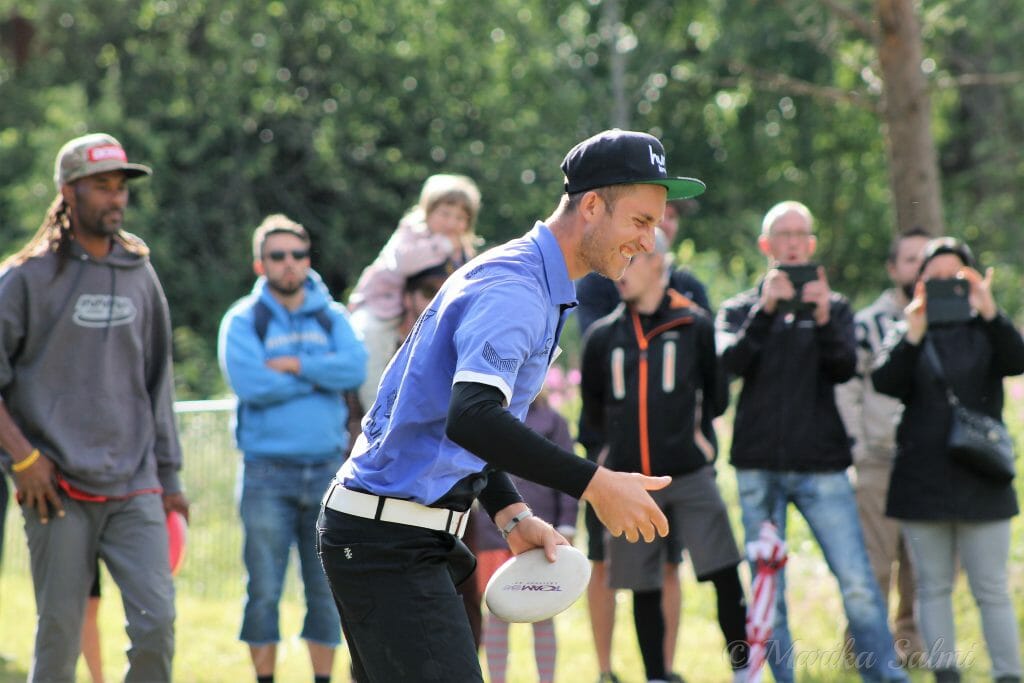
Ricky Wysocki at the 2018 Tyyni. Photo: Marika Salmi
In The Bag videos may serve as an engagement machine for pros, but with so many players making a big switch this year, they’ll likely hold more water than normal when it comes to predicting the 2022 season. How Catrina Allen replaces her F7 or Dickerson his FX-2 both are interesting questions, but, for my money, I want to see how Ricky Wysocki’s bag shakes out after his move to Dynamic Discs. With two world titles under his belt with Trilogy, it’s likely that he has some old favorites he’s excited to dust off. However, there’s so much more to explore in the Trilogy lineups than when he last represented them. Harp vs. Slammer, Defender vs. Rive — we saw Ricky reach for the less heralded Innova Whale last season in big moments, what will he settle on for his putting putter in 2022?
Wysocki was a cut above in 2021, and while I’m a firm believer of archer over arrows, it’s still a focal point of at least the early stretch of the season. He talks about his plan for Las Vegas Challenge in today’s Upshot Interview Series.
– Cam Guidry
The “Grassroute” or Commercial Takeoff?
The Disc Golf Pro Tour is now the official pro tour of the PDGA.
For as long as disc golf has been around, it has had a well-deserved underground, grassroots reputation, but since its inception as an organized sport, it has also been a commercial venture. After all, the DGA and PDGA were founded by a department head of a 1960s toy company. Until the last two years, the spread of elite competitive disc golf has largely been in pockets around the United States and Northern and Eastern Europe with a national and international tour to connect everyone in the Frisbee Family diaspora.
The 2021 COVID outdoor sports boom brought exponential growth for disc golf on a level unheard of in the sport’s history, and the Disc Golf Pro Tour capitalized on several broadcast opportunities, but the last two years wasn’t without friction. The PDGA is a slow-moving machine by nature, as a non-profit with a board of directors elected by the player base, and was roundly criticized for poor handling of National Tour tournaments and Majors compared to DGPT stops, but elite tournaments will now be operating under the proven methods of the for-profit Pro Tour.
There has always been a push and pull between the sport’s executive level and the local player/organizer base. The grassroots nature of disc golf’s growth over the last 50 years is at a turning point with the tour unifying under the DGPT banner and more eyes on the sport than ever. The DGPT is still working out some kinks in their processes, but it is now the biggest growth engine disc golf has seen since Headrick’s network of regional pros. Disc golf’s elite players will enjoy a higher level of tournament administration proven by the DGPT in the past two years, but does this signal a larger move away from the grassroots spirit that brought many into the sport where top pros are easily accessible to and, in some cases, rely on fans to bolster their bags with out-of-stock discs?
Will the influx of new players who are often unaware of disc golf’s history change the culture of the game writ large? The 2022 season will be a bellwether for how much of disc golf’s grassroots kinship is sacrificed in the name of growth, and what influences will remain from the tight-knit group born of the PDGA’s transition from a profit-focused business to a player-run non-profit.
– Gabe LaBounty
The Next Rookies of The Year
Micah Groth could be in the running for 2022 Rookie of the Year. Photo: Hayden Henry — PDGA.
5-time world champion Juliana Korver raised eyebrows when she won the 2021 DGPT Rookie of The Year award. So much so that the DGPT felt they needed to change the qualification rules. Under the new rules, the DGPT Rookie of the Year will go to the MPO and FPO players with the highest point total who has not played in more than three DGPT Elite Series, National Tour, or Major tournaments in a single previous season. Players who have competed in two or more Majors in a single previous season are also ineligible.
These new rules narrow the field of which players are most likely to win the DGPT ROY in 2022. The more events a player attends, the more chances they have to amass the tour points needed to win, so the first place to look for contenders is this list of tour card recipients. Of the 84 men and 37 women who were able to get tour cards, I counted only seven players that would qualify for Rookie of the Year. In MPO, those players were Micah Groth, Issac Robinson, Kristo Raik, Lauri Lehtinen, and 2021 European Disc Golf Champion Niklas Anttila. For FPO, I found Aria Castruita and Keiti Tätte.
There is still a good chance someone without a Tour Card can place high enough at DGPT and Major events to win ROY. For example, 1035-rated Linus Carlsson does not have a tour card yet announced a pretty extensive tour in the US for the early part of 2022 and said the DGPT (and Majors) are his focus. Another contendor for ROY, Iceland’s Blær Örn Ásgeirsson, told me he had already registered for many of the early season tournaments before the tour card became available.
While the Europeans are probably the favorites to win the MPO Rookie of the Year award, perhaps a young American can follow the Gannon Buhr path to stardom. Buhr, the 2019 PDGA Junior World Championship, took the pro tour by storm in 2021 en route to his ROTY award. Micah Groth seems like a good candidate after his win at the 2021 NADGT-National Championship and third-place showing at PDGA Junior Worlds. On the FPO side, Aria Castruita has a very promising future after her wins at both PDGA Junior Worlds and the NADGT-National Championship. Stacie Hass, who finished second at 2021 PDGA Junior Worlds, also seems to be preparing for a full tour.
Either way, it is very unlikely we will have another ROY who comes into the season with a Hall of Fame-worthy resume. Sorry, Des Reading and Scott Stokely!
– Jesse Weisz
Who Will Finish the Year at #1 in the World?
Paige Pierce at the 2021 Ledgestone Open. Photo: DGPT
This is a question every year, of course, but it’s been a while since we’ve really seen the full field of elite disc golfers all competing together at the biggest tournaments. Paige Pierce finished at #1 despite a poor finish to her 2021 season, but she wasn’t at her sharpest for much of the second half of the year and was outright beat by Kristin Tattar twice, despite Tattar not playing many events. The race for the top spot in FPO feels more open than ever before after years of dominance from Pierce.
MPO, too, is intriguing. Multiple top players have new bags, some top pros are playing more extensive tours, and the ascendance of young talent like Calvin Heimburg, Eagle McMahon, and Kyle Klein seems poised to topple the Paul/Ricky era.
Could this be the year? People thought Roger Federer and Rafa Nadal would be mothballed a long time ago, too, and those guys keep winning majors. Ricky comes into the season at #1, and McBeth was the best player at the Majors in 2021, despite getting Worlds ripped away from him from 247′ away.
But their grasp on the top spot is no longer assured. Eagle McMahon is only one rating point behind Wysocki and is two ahead of McBeth, and Heimburg and Chris Dickerson are not far behind. Adam Hammes and Klein are surging. And who knows just how good the Europeans will be after two years off the tour?
The Icelandic wunderkind is ready for a full tour.
February 23, 2022 by Bogi Bjarnason, Jesse Weisz and Steve Andrews in Interview with comments
Blær Örn Ásgeirsson at the 2018 British Open. Photo: Steve Hurrell
This is the the fifth of our Q&A interviews in our European Re-Open series that highlights European disc golfers as international travel reopens in 2022.
This past summer, I sat down for an interview with Blær Örn Ásgeirsson, Iceland’s top disc golfer. Also joining us was Bogi Bjarnason, Innova’s team manager for Iceland and one of the prominent figures in Icelandic disc golf. At the time, Blær had a 1017 rating, nearly 70 points higher than his next closest countryman.
Blær won his first MPO and A-tier appearance at age 14. He has since gone on to win the 2018 British Open, 2019 Open de España, 2021 Belgian Open, and the 2021 PCS Sula Open. He is also a 3x Iceland National Champion. He recently finished high school and at 19 years old is going to take on a full touring schedule this year.
Ultiworld DG: What would you say is the best part of your game right now?
Blær Örn Ásgeirsson: Probably my putting. I think I also have a good mental game. I almost never get angry on the course
Are you a spin putter or a push butter?
I’m a spin putter. It’s almost impossible to push putt in Iceland with the crazy wind we have almost all year.
Do you lean on a particular throw? Forehand? Backhand?
I mainly throw backhand. If I can throw backhand, I will.
What are the challenges of playing in Iceland in terms of the courses that you play?
We don’t have a lot of trees. We have mostly just big bushes. So we just throw over the bushes with hyzers. So mainly it’s just distance control and try to stay in bounds because we have a lot of OB. Not a lot of tunnel shots or low ceiling shots.
What do you do to challenge yourself to learn those shots?
I try to play different shots on the holes. Like when I’m practicing, I don’t just throw the hyzer on every hole. I throw low shots, straight shots, anhyzers, and sometimes do field work as well.
Have you played any tournaments where you had to play courses that are more technical?
Oh, yeah, for sure. Like a couple of months ago, I played the PCS Open and one of the courses there was super woodsy. That was a challenge for sure, but fun.
How do you adjust your games for the woods?
I feel like I’ve just had to learn new discs. I started throwing the Leopard3. It’s like a hyzer flip disc. I never throw Hyzer flips in Iceland. So it’s a different shot, but I think I can figure it out.
What is your touring plan for 2022?
I will go to the United States at the beginning of the year and travel for a couple of months with Knut Håland and Peter Lunde, who are from Norway. And in the mid-summer, I want to play the European tour, like the PCS Sula Open, European Open, Estonian Open, all those big tournaments. [Ásgeirsson is signed up for US tour stops from LVC this weekend through DDO in late April before returning to Europe.]
And financially, how do you support yourself playing disc golf now?
We have a pretty good disc golf community in Iceland. They have been supporting me with buying my discs and competing in my fundraising tournaments. So they helped me, and Innova helps me, and I’ll probably also work in the offseason. And the cash prizes.
Who are your sponsors?
My sponsors are Innova Champion discs, Frisbigolfbúðin, Frisbígolffélag Reykjavíkur, European Birdies, treelove disc golf, hleðsla.
What do your parents think about your burgeoning disc golf career?
They are always super supportive in everything I do and the same goes for my disc golf career.
What has been your biggest win so far?
Probably the PCS Sula Open.
You’re way out in front of the pack in Iceland. Who is the second highest-rated player?
I think there are two players now tied at like, 955 or something around that. [Mikael Máni Freysson is the second highest rated player at 954.]
So you’re rated 1021 right now1, and your top competitors in Iceland are in the 950s? How does that affect you in terms of having competition and improving your game while having been somewhat isolated due to COVID?
Yeah, I’m not really thinking about the competition. I mainly think about the rating. I try to average above my rating, so I’m more competing with myself. But this year, I haven’t been doing that well because I had a good first round, played like 1050, 1060, 1070 and almost won the tournament in the first round. And after that, I just lost my focus, just throwing some bad shots.
Do you have a goal for 2022?
I definitely want to qualify for the USDGC again and maybe get a cash prize in each tournament. And it’s always fun to get a higher rating.
Given the choice between playing more in Europe or the United States, are you going to prioritize one over the other?
All the big competitions in Europe are in the mid-summer, so I definitely want to compete in those, but other than that I plan on spending most of my time in the US.
What is the visibility of disc golf in Iceland? If I asked 10 people if they’ve heard of disc golf, how many of them would have heard of disc golf?
Blær: I would think 4.7.
Bogi: I would guess 7 out of 10.
Blær: They did a poll of how many people in each age group have played disc golf. It was something like of the ages 17 to 26 or something like 47% have played disc golf in the last year. Because of those numbers now, we have more money to make more courses.
Bogi: In Reykjavik, you have a city of 200,000 people with 14 courses in sight. You can see people playing, you know, because it’s everywhere, so it’s very hard not to know what disc golf is.
What’s the difference between pre-pandemic disc golf and how things are now in Iceland?
Bogi: The summer of 2020 was just mind-blowing. It was different this year because some restrictions have been lifted. There are other things to do. But last summer, people were unemployed and working from home, gyms were closed, and you couldn’t go to the bars. Just looking at sales from my van, they went up, I think, 40%.
Blær: Before the pandemic, you could play all the courses easily, but now you have to wait in line on almost every course.
How do you think disc golf will change in Iceland over the coming years? How is it going to compare to the rest of the world?
Bogi: Our problem is that we need more championship-level courses. We need the sport to be treated as a sport by the powers that be, not just a hobby. Making eighteen hole courses, having cash prizes in tournaments, and attracting more sponsors to the tournament.
Blær: Now we only have events with no payouts. I feel like all the focus is on getting new players to the sport.
Bogi: Many of these players don’t stick around because there’s no challenge. We play these pitch-and-putts and there’s nothing else. This is almost like a multi-level marketing thing. Oh, recruit, recruit, recruit, but don’t do the groundwork to make it a professional sport.
When you look at UDisc, there are a lot of 9 hole courses in Iceland, which seems very unusual compared to other countries. Do you know why that is so?
Bogi: We know. It is because of the powers that be.
Blær: And probably, it’s hard to get the space for an 18 hole course, especially in Reykjavik. And all the big parks with the big trees. There’s no way to put a course there. So it’s hard to get the courses with trees.
Bogi: If you look at the UK, I mean they’re not nearly as developed as us, but they have way better courses. It’s because they put them outside the city. Here, they only build them inside the city.
Blær: We probably have the worst landscape in the world for disc golf. There are no trees. We just had to put in a lot of mandos and OB.
So trees just don’t grow well in Iceland?
Bogi: We have trees, it’s just not the kinda trees that work well as obstacles to shape a shot. We apparently used to have woods. They say they were all cut down hundreds of years ago.
Stacie Rawnsley picked up the game in 2019 and decided to pursue pro status after she lost her job during the pandemic.
FISHERS, Ind. — Fishers native Stacie Rawnsley has always liked throwing things. She was a pitcher for the Fishers High School softball team, went on to play at the next level and also picked up ultimate frisbee in college.
Just two years ago, she turned her attention to disc golf.
“There’s just something so beautiful about flight of disc,” Rawnsley said. “Once you see one fly with like an ‘S’ shape and just see how far it can really go, you’re just so ecstatic about it. It brings so much joy to you and you don’t know why.”
Rawnsley was first introduced to the sport back in 2019 when a friend brought her to a disc golf course. She admits she was a little skeptical at first.
“I was like ‘no, disc golf is gonna be lame’ and then I got a disc to fly correctly for the first time and I just became absolutely hooked on it.”
Rawnsley picked it up quickly because of her background in softball and Frisbee. In the beginning, it was really just for fun. Then, during the pandemic in March of 2020, Rawnsley lost her job as a pet store manager in Indianapolis. That’s when she decided to take the leap and go pro.
“I had two months because you could social distance while playing disc golf. You just don’t putt into the baskets so I was able to practice a ton for the two months everyone was on lockdown, so I was like ‘why not?’”
Now a rookie on the Professional Disc Golf Association Tour, Rawnsley has spent the last few months competing in events all over the country. She travels the country solo in her Honda Element with a small camper attached to the back.
“I sleep in that and I literally just travel across the U.S. in a car and sleep wherever I want. I mean, that’s an adventure right?” she said.
It is an adventure and Rawnsley is succeeding along the way, currently ranked in the top 20 in the PDGA standings. This week, she’s competing in the Disc Golf World Championships in Ogden, Utah.
“My goal is to achieve top 30, which I think is very doable,” she said.
Rawnsley said she plans to join the tour again next year and hopefully beyond. She also says she wants to buy a bigger camper.
“I have goals to get a touring van and deck it out to live in something much more livable than my car and little pod. So yeah, I’m definitely going to be doing this long term.”
America’s SBDC at Tarleton State University’s presents an upcoming webinar titled “Use Youtube to Grow Your Business” at 2 p.m. Wednesday, Feb. 23.
Learn how to use YouTube and the power of video to promote your business or brand.
In this workshop we’ll cover:
• Creating and organizing a YouTube channel
• Adding videos and streaming with YouTube Live
• Video ad formats
To register, go to register.gotowebinar.com/register/692259536711535628
Center hosting COVID-19 vaccine clinic
Doctors Medical Center, a primary care health clinic, located on the main campus of the Comanche County Medical Center (CCMC) offers COVID-19 vaccines and boosters every Wednesday from 10 a.m. to 1 p.m.
Moderna vaccines are customarily administered 10-11:30 a.m., Pfizer vaccines from 11:30 a.m. to 1 p.m.
Get on the schedule by calling the clinic at (254) 879-4910.
Doctors Medical Center is located at 10201 Highway 16 North, Comanche (midway between De Leon and Comanche).
Hearsay hosting live music, comedian
Hearsay Wine Bar, 270 W College St., is hosting live music and comedy at its new patio bar from 6-9 p.m. Wednesday, Feb. 23.
Come join us on the patio and listen to the Immediate Blues music and stand-up comedian Bill Muncey. Hearsay Wine Bar is open 4-10 p.m.
For more information, call (254) 434-2244.
Senior Center hosting Chili Cookoff
Stephenville Senior Citizen Center, 164 E. College St., is hosting a Chili Cookoff at 10 a.m. Thursday, Feb. 24, for National Chili Day.
Setup will be from 10-10:45 a.m. with judging beginning at 11 a.m.
This is for amateur cooks only and individual entries, no teams. Contestants may be of any age.
There is a $5 entry fee.
For more information and specific rules, contact the center at (254) 918-1288 or find them on Facebook at www.facebook.com/stephenvilleseniorcitizencenter/
Volunteers sought to plan Dublin Easter Egg Hunt
Would you like to be involved with planning and holding a community Easter Egg Hunt in April? Dublin DQ’s manager Shanna Phelps, has stepped up and offered to lead a group of volunteers to make an event happen here in Dublin.
Join volunteers at the Dublin Texas Chamber of Commerce, 110 S. Patrick St., at 2 p.m. Friday, Feb. 25 to flesh out ideas and plan the event.
We need your help to make this event happen for our community.
Homelessness Help hosting free lunch
Homelessness Help is hosting a free lunch from 11 a.m. to 1 p.m. on Saturday, Feb. 26, at the Family Center of Graham Street Church of Christ, 375 Graham St.
The organization will continue this on the second and fourth Saturdays of each month.
Homelessness Help is dedicated to preventing, reducing and combating homelessness in Erath County by ensuring that an effective system of care and services is in place.
For more information, call (254) 595-3646 or email [email protected]
Open house to benefit fishing team
Outdoor Specialties, 10402 IH 20 Access Road, Eastland, is hosting its second annual open house from 10 a.m. to 3 p.m. on Saturday, Feb. 26.
There will be raffle drawings for the following: Raptor X 42” Zero Turn Mower; Tracker Off Road 300 4Wheeler; and a 2022 Bass Classic XL w Mercury Motor
Tickets are $25 each or five for $100. You do not have to be present to win.
The event will feature door prizes, giveaways, pro staff seminars, and a food truck.
To purchase tickets, call (254) 629-8877 or stop by Outdoor Specialties.
All proceeds from the event will benefit the Eastland County High School Fishing Team.
CASA hosting informational sessions
CASA for the Cross Timbers Area is providing online informational sessions on Tuesdays through March 29.
Dates are: March 1, noon-1 p.m.; March 8, 6-7 p.m.; March 15, noon-1 p.m.; March 22, 6-7 p.m.; and March 29, noon-1 p.m.
These are no-obligation introductions to CASA and its mission to provide abused and neglected children in foster care with CASA volunteers who can speak up for their well-being.
Join CASA staff and current Advocates as they discuss what it means to be a Court Appointed Special Advocate, or CASA, the increasing need for additional volunteers, and how community members can help make a difference in the life of children in foster care.
All sessions will be held via Zoom. For more information or to sign up for a session, visit them on Facebook at www.facebook.com/www.CASAfortheCrossTimbers
Clark Gardens, 567 Maddux Road, Weatherford, announces a new month-long event, “Grow at Clark Gardens”, highlighting nature-based activities while encouraging healthy lifestyles.
Throughout the month of March, “Grow at Clark Gardens” will host events, both weekdays and weekends, designed to enrich the lives of our local citizens and tourists through art, wellness, gardening, and other nature-based activities.
Each week will wrap up that week’s topic with a weekend vendor market. There will be vendor booths with locally made goods and local services offered. Vendor markets will be Saturday 10 a.m. to 5 p.m., and Sunday 10:30 a.m. to 5 p.m.
For weekly topics, visit www.clarkgardens.org
General admission is $7 for seniors 65 and older; $9 for adults; and $5 for children ages 4-12. In addition, optional fees will be available for purchase through vendors and professional events located throughout the garden.
For more information, contact Nigel Benavides at (940) 682-4856.
Senior Center hosting country dance
Stephenville Senior Citizen Center, 164 E. College St., is hosting a country and western dance from 7-9 p.m. Tuesday, March 1.
Dust off those dancing shoes and come boot scoot to music by Cowboy Country Productions, sponsored by Andy’s Tires.
The center hosts a dance each first Tuesday of the month.
Entries sought for St. Patrick’s Festival parade
The community of Dublin is gearing up for its annual St. Patrick’s Festival and is seeking parade entries for the event.
The parade is scheduled for 10 a.m. Saturday, March 12, with check-in beginning at 9 a.m. at the corner of North Post Oak and East Clinton streets.
Judging of entries will begin at 9 a.m. with awards presented before the parade begins.
There is no entry fee, but an entry form must be filled out. No candy or other objects are allowed to be thrown from vehicles.
For more information or to enter the parade, visit the Dublin Chamber of Commerce at 110 S. Patrick St., email [email protected] or text (254) 300-6263.
Shamrock Shootout part of St. Patrick’s festivities
The Shamrock Shootout 2022 disc golf tournament will be held in conjunction with this year’s St. Patrick’s Festival in Dublin.
The tournament is set to begin at 9 a.m. Saturday, March 12, at Dublin City Park, 216 N. Highland Ave.
Hosted by the Dublin Disc Golf Club, this doubles tournament is a bring-your-own-partner event with entry fee of $25 per person.
There are three divisions: beginner, advanced and open. This is a two-round, 19-hole course.
For more information or to join the tournament, find the Dublin Disc Golf Club on Facebook.
Shamrock Shuffle 5K part of St. Patrick’s event
The Shamrock Shuffle is scheduled for Saturday, March 12, as part of the St. Patrick’s Day Festival in Dublin.
Race time is 7:30 a.m. and starts at the Dublin Public Library, 206 W. Blackjack St.
Entry fee for the 5K is $25 before March 1 and goes up by $5 after March 1. Children younger than 10 are admitted for $15. T-shirts are guaranteed for entrants who pay the fee before March 1.
Race packet pickup is 3-7 p.m. Friday, March 11 at Titan Fitness.
Race day registration is from 6-6:45 a.m. Awards will be given after the race for the top three male and female age divisions and to the overall male and female winners.
5K division include: 5 and younger; 6-10; 11-15; 16-19; 20-24; 25-29; 30-34; 35-39; 40-44; 45-49; 50-54; 55-59; 60-69; 70-79; and 80 and older.
For more information or an entry form, contact Titan Fitness at (254) 445-3001, http://www.titanfitnessdublin.com/ or via Facebook.
Senior Center hosts monthly Book Club meeting
The Stephenville Senior Citizen Center has lots of fun upcoming books as part of its Book Club.
The Book Club meets each first Thursday of the month at 1:30 p.m. at the center, 164 E. College St., to discuss the book.
Upcoming books include:
• March 3: “Welcome to the Departure Lounge” by Meg Federico
• April 7: “The Things We Cannot Say” by Kelly Rimmer
• May 5: “The Spiral Shell” by Sandell Morse
• June 2: “Project Hail Mary” by Andy Weir
• July 7: “News of the World” by Paulette Jiles
For more information contact the center at (254)918-1288.
Foster’s annual auction set for March 5
Foster’s Home for Children, 1779 N Graham St., will host its annual auction on Saturday, March 5.
The Outdoor/Silent Auction begins at 9 a.m. The indoor auction begins at noon with vehicles, etc., to follow.
A barbecue lunch will be available for $5 beginning at 11:30 a.m.
You can support the children at the Foster’s Home either by donating an item or bidding on an item.
Contact Lacy Barton at (254) 968-2143 to donate an item.
New Jersey, United States,- The latest report published by Verified Market Reports indicates that the Disc Golf Market is likely to accelerate strongly in the coming years. Analysts have studied market drivers, restraints, risks, and opportunities in the global market. The Disc Golf Market report shows the likely direction of the market in the coming years along with its estimates. An accurate study aims to understand the market price. By analyzing the competitive landscape, the authors of the report have made excellent efforts to help readers understand the key business tactics that major companies are using to maintain market sustainability.
The report includes company profiles of almost all major players in the Disc Golf market. The Company Profiles section provides valuable analysis of strengths and weaknesses, business trends, recent advances, mergers and acquisitions, expansion plans, global presence, market presence, and portfolios of products from major market players. This information can be used by players and other market participants to maximize their profitability and streamline their business strategies. Our competitive analysis also provides vital information that will help new entrants identify barriers to entry and gauge the level of competitiveness in the Disc Golf market.
Get Full PDF Sample Copy of Report: (Including Full TOC, List of Tables & Figures, Chart) @https://www.verifiedmarketreports.com/download-sample/?rid=135502
Key Players Mentioned in the Disc Golf Market Research Report:
By the application, this report covers the following segments:
• Professional Competition • Amateur • Others
The global market for Disc Golf is segmented on the basis of product, type. All of these segments have been studied individually. The detailed investigation allows assessment of the factors influencing the Disc Golf Market. Experts have analyzed the nature of development, investments in research and development, changing consumption patterns, and growing number of applications. In addition, analysts have also evaluated the changing economics around the Disc Golf Market that are likely affect its course.
The regional analysis section of the report allows players to concentrate on high-growth regions and countries that could help them to expand their presence in the Disc Golf market. Apart from extending their footprint in the Disc Golf market, the regional analysis helps players to increase their sales while having a better understanding of customer behavior in specific regions and countries. The report provides CAGR, revenue, production, consumption, and other important statistics and figures related to the global as well as regional markets. It shows how different type, application, and regional segments are progressing in the Disc Golf market in terms of growth.
Get Discount On The Purchase Of This Report @ https://www.verifiedmarketreports.com/ask-for-discount/?rid=135502
Disc Golf Market Report Scope
ATTRIBUTES
DETAILS
ESTIMATED YEAR
2022
BASE YEAR
2021
FORECAST YEAR
2029
HISTORICAL YEAR
2020
UNIT
Value (USD Million/Billion)
SEGMENTS COVERED
Types, Applications, End-Users, and more.
REPORT COVERAGE
Revenue Forecast, Company Ranking, Competitive Landscape, Growth Factors, and Trends
BY REGION
North America, Europe, Asia Pacific, Latin America, Middle East and Africa
CUSTOMIZATION SCOPE
Free report customization (equivalent up to 4 analysts working days) with purchase. Addition or alteration to country, regional & segment scope.
Geographic Segment Covered in the Report:
The Disc Golf report provides information about the market area, which is further subdivided into sub-regions and countries/regions. In addition to the market share in each country and sub-region, this chapter of this report also contains information on profit opportunities. This chapter of the report mentions the market share and growth rate of each region, country and sub-region during the estimated period.
• North America (USA and Canada) • Europe (UK, Germany, France and the rest of Europe) • Asia Pacific (China, Japan, India, and the rest of the Asia Pacific region) • Latin America (Brazil, Mexico, and the rest of Latin America) • Middle East and Africa (GCC and rest of the Middle East and Africa)
Key questions answered in the report:
1. Which are the five top players of the Disc Golf market?
2. How will the Disc Golf market change in the next five years?
3. Which product and application will take a lion’s share of the Disc Golf market?
4. What are the drivers and restraints of the Disc Golf market?
5. Which regional market will show the highest growth?
6. What will be the CAGR and size of the Disc Golf market throughout the forecast period?
For More Information or Query or Customization Before Buying, Visit @https://www.verifiedmarketreports.com/product/global-disc-golf-market-report-2019-competitive-landscape-trends-and-opportunities/
Visualize Disc Golf Market using Verified Market Intelligence:-
Verified Market Intelligence is our BI-enabled platform for narrative storytelling of this market. VMI offers in-depth forecasted trends and accurate Insights on over 20,000+ emerging & niche markets, helping you make critical revenue-impacting decisions for a brilliant future.
VMI provides a holistic overview and global competitive landscape with respect to Region, Country, and Segment, and Key players of your market. Present your Market Report & findings with an inbuilt presentation feature saving over 70% of your time and resources for Investor, Sales & Marketing, R&D, and Product Development pitches. VMI enables data delivery In Excel and Interactive PDF formats with over 15+ Key Market Indicators for your market.
Visualize Disc Golf Market using VMI @ https://www.verifiedmarketresearch.com/vmintelligence/
Top Trending Reports
Global Toilet Potty Seat Covers Market Size And Forecast
Global Telecoil Market Size And Forecast
Global Disc Golf Market Size And Forecast
Global Storage Water Tank Market Size And Forecast
Global Allround Sup Market Size And Forecast
Global Stain Remover Products Market Size And Forecast
Global Complelte Face Brush Market Size And Forecast
Global Cake Market Size And Forecast
Global Bottled Water Market Size And Forecast
Global Fetal Favorite Market Size And Forecast
About Us: Verified Market Reports
Verified Market Reports is a leading Global Research and Consulting firm servicing over 5000+ global clients. We provide advanced analytical research solutions while offering information-enriched research studies.
We also offer insights into strategic and growth analyses and data necessary to achieve corporate goals and critical revenue decisions.
Our 250 Analysts and SME’s offer a high level of expertise in data collection and governance using industrial techniques to collect and analyze data on more than 25,000 high-impact and niche markets. Our analysts are trained to combine modern data collection techniques, superior research methodology, expertise, and years of collective experience to produce informative and accurate research.
Our research spans over a multitude of industries including Energy, Technology, Manufacturing and Construction, Chemicals and Materials, Food and Beverages etc. Having serviced many Fortune 2000 organizations, we bring a rich and reliable experience that covers all kinds of research needs.
WARREN — Warren city schools will keep its mask-wearing mandate for students and staff in place for now until there is more changes in the COVID-19 numbers, school officials said.
School Superintendent Steve Chiaro said at Tuesday’s school board meeting that masks mandates will remain in place for Warren schools, but he and other superintendents are watching the case numbers, which have been decreasing lately.
Board member Jenna Daugherty said some school districts have gone from “mask required” to “mask recommended.”
Chiaro said Trumbull County and Warren city health officials still are advising to keep the mask-wearing requirement in place.
“I listen to the local health officials on what they recommend. We are watching the data and number of cases locally to see what we will do in upcoming months,” Chiaro said.
He said at least eight or more Trumbull County public schools are requiring masks for students and staff.
“The first of the year the (COVID-19) cases were very high. We have been seeing a reduction since then and hope that continues. After that we will discuss adjusting the mask mandate, Right now we will continue to closely monitor the numbers,” Chiaro said.
Chiaro said he and other local school superintendents are meeting this week with county and city health officials to discuss the upcoming months of classes.
“it has been a trying time for everyone in the schools and community,” said board member Julian Walker who asked families to be patient.
In other business, Chiaro said the porch remodeling project on the old Harding High School facade has been temporarily delayed due to the recent heavy snow and cold weather.
He said the project, which costs over $100,000, is set to begin again once the weather improves.
“With weather like we have been having, we can’t pour cement or do what we need to do to fix the porch. We are getting close to getting the project done, but the weather has put us back a little,” Chairo said,
In other action, the board:
• Learned from Chiaro that the district has received a $234,090 grant from the Ohio Department of Transportation to be used to help buy three school buses.
• Learned from Chiaro the district will receive a donation of golf disc nets from Young Run’s Disc Golf Course in Champion He said the Champion course received a grant from the Disc Golf Association to replace equipment there. The older equipment will be given to Warren for setting up three courses near schools.
• Reported the McGuffey School Titonics robotics team — led by parent Amanda Colbert and others — will compete March 6 at state championships in Dayton, marking the second time the team has reached that level of competition.
February 22, 2022 by Charlie Eisenhood in News with comments
JomezPro founder Jonathan Gomez. Photo: Alyssa Van Lanen — PDGA.
After six months of negotiations, the Disc Golf Pro Tour and JomezPro signed a contract yesterday, granting the YouTube media company rights to produce and distribute lead card MPO coverage at DGPT Elite Series events and select PDGA Majors for two years for a $500,000 fee.
“Our goal for the last few years has been to secure a multi-year deal with the Disc Golf Pro Tour,” said JomezPro founder and owner Jonathan Gomez. “And we’ve worked really hard to get to this point.”
JomezPro, which leads disc golf channels with more than 360,000 subscribers on YouTube, will produce next-day post-produced MPO lead card coverage at all DGPT Elite Series events in 2022 and 2023, along with MPO lead card coverage at PDGA Pro Worlds and the PDGA Champions Cup, both majors. They will return to the US Women’s Disc Golf Championships to provide lead card FPO coverage as well.
This is the first time that Jomez has paid a significant sum for rights to film and distribute disc golf. Recent deals with the DGPT have been focused around advertising trade; past arrangements even included the PDGA and DGPT paying Jomez to cover their events. “We always knew there would be a time when we had to put up significant investment to secure rights to MPO lead card coverage,” said Gomez, who noted that the effort that Jomez has put into elevating the profile of disc golf online helped turn the property into a valuable one.
“The terms that we agreed to with the Pro Tour was a really good middle ground for both parties,” he said. “[The rights fee] really helps us show the sport how committed we are to ensuring the growth of the sport. And in terms of the DGPT, it helps them increase purse sizes and continue to elevate their strategy as well, which is why we’re here.”
“The value generated through media, in 2022, will be put right back into event support, continued purse growth, and another record-breaking DGPT Championship payout,” said DGPT CEO Jeff Spring in a statement.
Gomez said that JomezPro now has nearly 20 employees and that this multi-year DGPT agreement makes it easier for the company to build towards a long-term media strategy and increase the quality of the product and content ideas. “Things cost more, but, fortunately, the disc golf community continues to support us in larger numbers and even just by watching videos,” he said.
The contract with the Pro Tour, who also controls media rights to select PDGA majors (but not the USDGC or European Open), also includes some advertising for the DGPT and PDGA.
The future of post-production coverage on YouTube remains uncertain. The DGPT is increasingly emphasizing its own live coverage platform, Disc Golf Network, which generates hundreds of thousands of dollars in subscription revenue. The DGPT is also working with producers GK Pro and Central Coast Disc Golf to put Silver Series post-produced content on its own YouTube channel in 2022.
“I’m actually really excited that I don’t know what it’s going to look like two years from now,” said Gomez. “…All we know is that if we continue to feed our energy and resources into it, it’s going to continue to grow.” He added that JomezPro plans to be involved in disc golf media no matter what the landscape looks like.
Jeremy “Big Jerm” Koling, Nate Sexton, and Paul Ulibarri — dubbed ‘Big Sexy Barri’ by fans — are set to return as commentators for Jomez in 2022. As for any changes to the production? “People are just going to have to wait until Friday,” said Gomez, referencing the release of the first round of Las Vegas Challenge coverage on YouTube.
Tilden residents enter the city library, bundled up against the cold. They greet each other between sips from their thermoses, then take a seat. Jordan Grummert-Rasmussen and Amanda Kowalewski, extension educators for Rural Prosperity Nebraska, welcome the attendees and begin the first meeting of the Entrepreneurial Communities Activation Process program.
Through a series of surveys, townhall meetings, and the creation and execution of locally designed projects, the ECAP program helps rural Nebraska communities revitalize their towns through entrepreneurship and business development.
“ECAP provides communities the space to reflect on their successes and assets, and in turn learn from and leverage these capacities to improve the quality of life for residents,” Grummert-Rasmussen said.
ECAP has two aims: to strengthen already existing assets and introduce new vitality to communities. The aims are defined by community members, who lead the discussions, set goals and complete projects.
Marilyn Schlake, co-lead for Rural Prosperity Nebraska’s Community Economic Development team, which heads ECAP, emphasizes the focus on each community’s individuality.
“It takes about two to three months to do this process,” she said. “Then (residents) have a plan to start moving forward. But the community decides all that.”
Molly Navratil, a Tilden City Council member, attended the inaugural ECAP meeting with hopes that moving forward didn’t mean abandoning the community’s culture.
“I hope that Tilden keeps its strong, awesome, positive identity,” she said, “but is able to grow in the things that it needs to leap into the future.”
Tilden is taking its first steps in the program, but communities across the state have already seen major improvements by participating.
In 2018, Plainview began the process with a communitywide survey that asked questions about housing, child care, food access, and community culture and vision. Within three years, it welcomed 19 new businesses and created 75 new jobs, remodeled its city park, received multiple federal grants and created a $200,000 revolving loan fund.
“Our main street is full. I have no buildings left,” said Susan Norris, director of Pierce County Economic Development. “ECAP focuses on the positive. It’s such an organic process.”
Plainview is only one example. Auburn is working on downtown revitalization efforts. Osmond is upgrading communitywide broadband service. Hadar created a disc golf course in its city park and is developing a 93-house subdivision.
While Tilden was beginning the ECAP process, just up the road, Atkinson residents were holding the “graduation” session of their year-long program, and they had much to celebrate. Participants reminisced about the progress their community has made, from expanding child care options to updating the community welcome packet — which is delivered to new residents in person — to creating a service-based website, which will launch in the coming months.
“Atkinson has benefitted from the ECAP program because I feel like we were comfortable, and this program came in and challenged us,” said Pam Winer, general property manager of the Sandhills Hotel and president of Atkinson’s Chamber of Commerce.
The crowning event was a career fair for high school students to explore opportunities in Atkinson, which resulted in many students earning employment and internships at local businesses.
Some people participated in the program for personal reasons, like Patti Skrlda, who promised her deceased father she would help “keep Atkinson alive,” she said.
Others joined the team from a professional standpoint, like Sheryl Hiatt, who works for the Nebraska Department of Economic Development.
“The ECAP process really lays the groundwork for economic development and community development,” she said. “My thing tonight is, I really want to know what’s next.”
A lot falls under that umbrella of “community development,” whether it’s a new restaurant, better child care centers, expanded housing or a revitalized main street. Either way, the spirit of ECAP is in its name — it’s a process.
From completing the first survey to cutting the ribbon on opening day, locals continually strengthen the economic climate in their communities long after the program is “finished.” Atkinson understood this concept, as the final slide of their celebratory presentation asked, “Ideas for future projects?”
After seeking public input, Fish Wildlife and Parks met with the Headwaters Advisory Board to review the Missouri Headwaters State Park master plan on Friday.
Members of the advisory board and the public shared their thoughts on future development in the state park.
Missouri Headwaters State Park is 532 acres of land dedicated to preserving cultural and historical landmarks while providing recreational opportunities for visitors.
Though many associate the area with the Lewis and Clark Expedition, Native American tribes used the land in and around the park for hunting, gathering and fishing centuries before the famous duo arrived.
While visitation of the park continues to increase, the public made it clear that it is more important to preserve and maintain the cultural and historical heritage of the area rather than develop it.
Marsha Small, a cultural preservationist and member of the Headwaters Advisory Board, encouraged FWP to update existing signage using accurate Native American history. She even suggested renaming the park (or areas within the park) to reflect the area’s native heritage.
Small also suggested that each tribe select a spokesperson to comment on FWP’s master plan for Missouri Headwaters State Park. Another advisory board member, Sara Scott, recommended that FWP make ongoing efforts to include tribal members in park discussions.
Many comments made by advisory board staff and the public focused on developing the park as little as possible.
“Keep what we have out there and make it better,” Gene Townsend said on behalf of the Three Forks City Council.
While many were against developing, there was some discussion about responsible growth in the park.
Potential developments discussed at the meeting included a visitors center, more camping sites, and a disc golf course.
Ron Pannesi, a member of the Headwaters Disc Golf Club, spoke in favor of adding a course to the state park.
According to Pannesi, disc golf courses have minimal impact on the land. He said the course would give visitors a new way to enjoy Missouri Headwaters State Park.
Alec Humphries, another disc golfer, said that local disc golfers care about preserving the land.
Humphries and Pannesi agreed that a disc golf course would attract more visitors. Because disc golf is an inexpensive sport, even low-income families can enjoy it.
“I’d like to see it (disc golf) grow in a sustainable way,” Humpries said.
Fish Wildlife and Parks will review the current Master Plan draft and consider the comments made by the public and advisory board members before publishing the final draft in the next two weeks.
FWP officials emphasized that the master plan is not the be all end all script for Missouri Headwaters State Park. They will continue speaking with the public before implementing any significant projects.
“The finalization of the master plan is not the end of the conversation,” Hope Stockwell, a member of FWP, said.