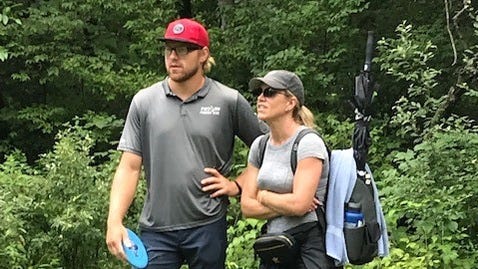
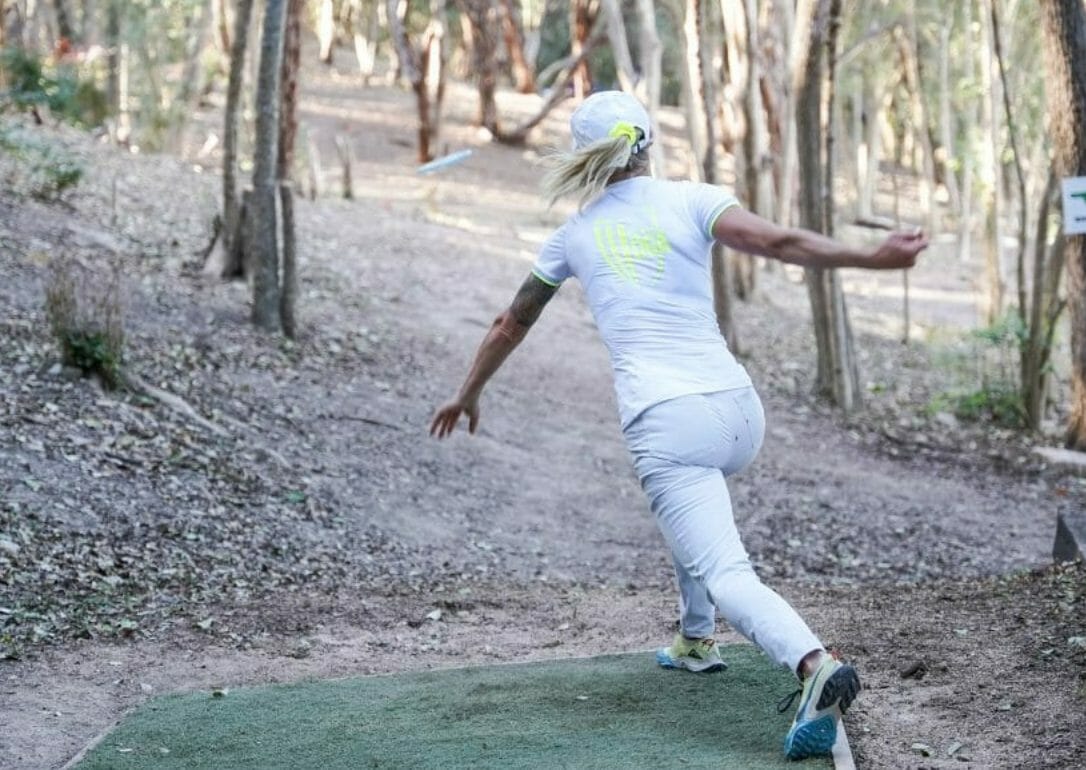
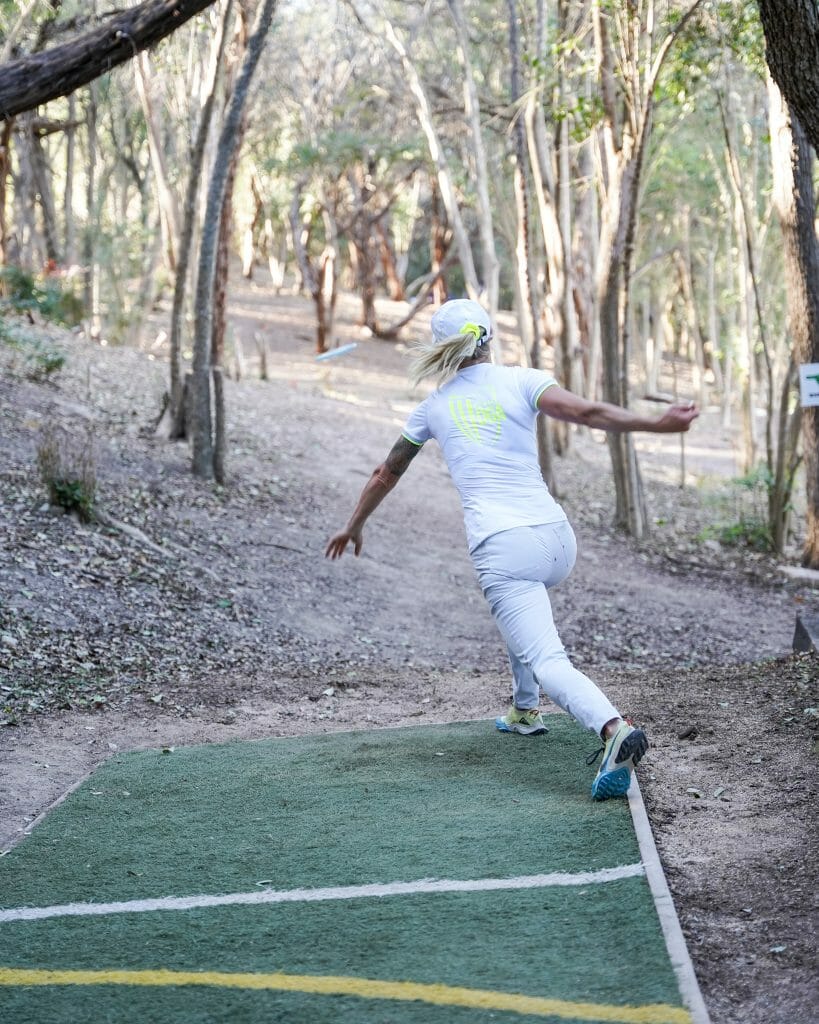
My experience on Armstrong campus closely mirrors that of the students in the Nickelodeon series Zoey 101. Like the students in the show, we have open access to the beach, pasta-obsessed RAs, and now: a disc golf team!
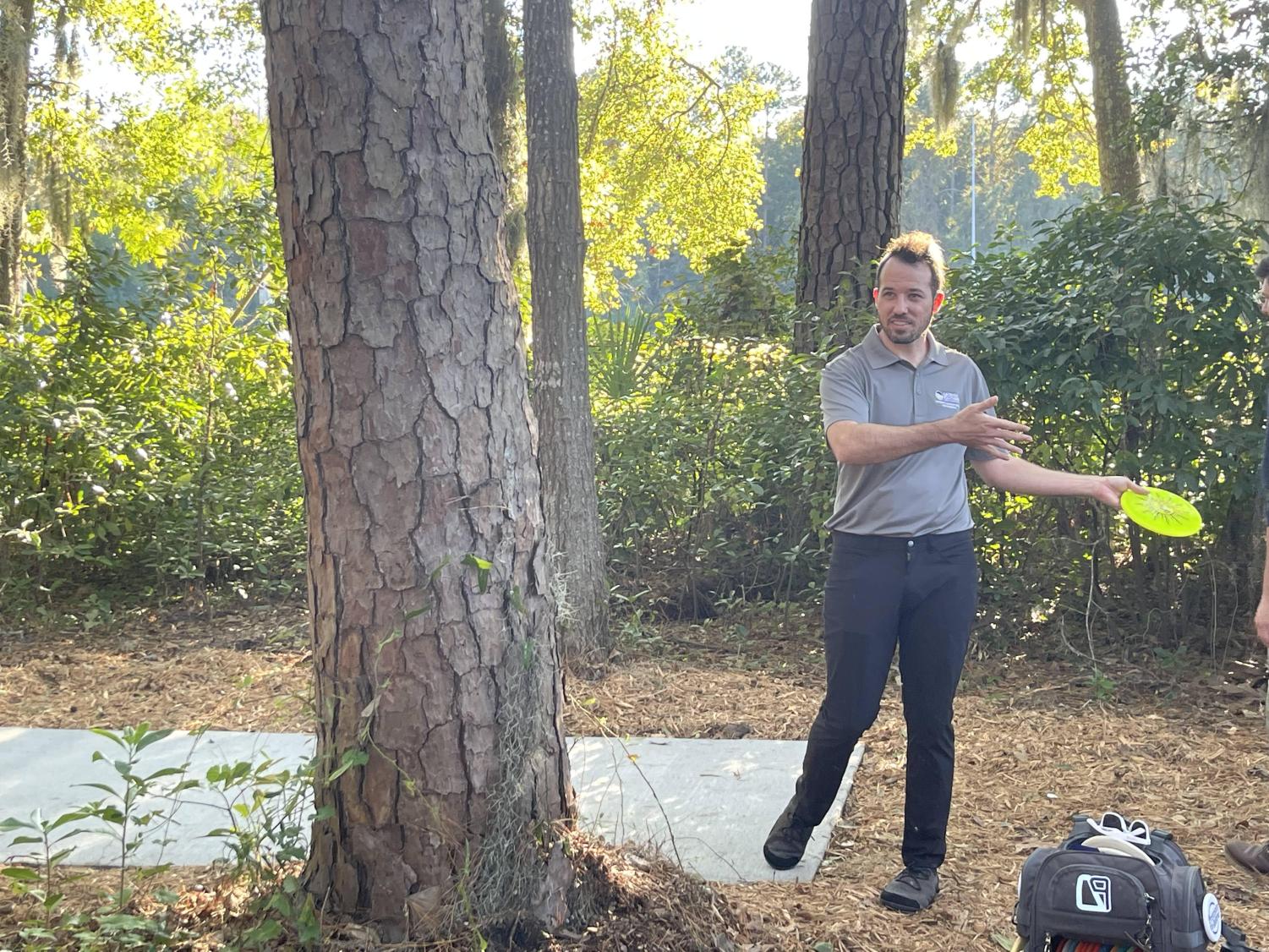
Disc golf takes the rules of golf and remixes them. In the place of golf balls and holes are discs and baskets. Some may confuse the discs used to play the sport with a frisbee, although the slightly different plastic material makes them more optimal for the sport.
“Whammo, is the trademark for the term Frisbee,” Wes Johnson, the new team coach, advised me. “If you call it frisbee golf to an avid disc golfer. Don’t be surprised if they correct you.”
Before I met with Wes, I’d always assumed the sport was played with the same cheap plastic toy that my dog obliterates in minutes. When I got to his office, he set a disc in one of my hands and a frisbee in the other.
“Frisbees are typically lighter, and if you throw it into a tree it’d probably break,” Wes said. “Whereas Disc Golf discs are designed to be thrown into trees, and metal, and all kinds of stuff.”
Last Thursday, I sat down with Wes to discuss the new course and team. On top of his new role as coach of the team, he is also currently The Treasurer and former President of The Savannah Disc Golf Association and an avid player of six years. “My wife works in the Recreation Department with Sean Willett. He’s the one that I worked with in helping get the course,” he advised me.
Two disc golf courses were established on and near the Armstrong Campus last semester. The first is located midway between Pooler and Savannah at Tom Triplett Park, and the second is right here on the Armstrong Campus. “We hired a professional disc golf course designing company to handle everything,” Wes explained.
“But once the course was put into the ground and there was student interest in forming a club, I had already laid the groundwork and both my wife and Sean knew that I’ve been playing disc golf for a bunch of years,” he continued. “And I had those ties with the local community so it was natural for them to ask me if I’d be willing to step in and help out with the students.”
Fliers were posted around campus by the club president, Matt Mahoney. “He is an active student, and I feel like he has a better voice to get other people involved. I’m here to help advise and help them improve.”
Once the team fully forms, they will compete as a collegiate disc golf team. Other participating universities will take turns hosting events. “Typically, they do team rounds or individual rounds,” Wes said. “The whole team plays together to get the best score possible.”
The team had their first two meetings this past week. “If anybody, even if they’ve never held a disc in their life, if they want to come and try to play, that’s fine,” Wes beamed. “They’re welcome to email me if they’re interested. Also, if they want to reach out to Sean Willett at the Rec Center, he would point them in the right direction as well.”
The courses are there for any student who’d like to try their hand at disc golf. Although, I will personally be using them as a vessel for my continued fantasy of attending the fictional Pacific Coast Academy.
Glob Market Reports offers an overarching research and analysis-based study on, “Global Disc Golf Market Report, History and Forecast 2016-2028, Breakdown Data by Companies, Key Regions, Types and Application“. This report offers an insightful take on the drivers and restraints present in the market. Disc Golf data reports also provide a 5 year pre-historic and forecast for the sector and include data on socio-economic data of global. Key stakeholders can consider statistics, tables & figures mentioned in this report for strategic planning which lead to success of the organization. It sheds light on strategic production, revenue, and consumption trends for players to improve sales and growth in the global Disc Golf Market.
Some of the key manufacturers operating in this market include:Innova Disc Golf, Prodiscus, GATEWAY DISC SPORTS, ABC Discs, Legacy Discs, Aerobie, Discraft, Discmania, Prodigy Disc, Daredevil Discs, DGA, Dynamic Discsand More…
Download Free PDF Sample Copy of the Report(with covid 19 Impact Analysis): https://www.globmarketreports.com/request-sample/223404
Here, it focuses on the recent developments, sales, market value, production, gross margin, and other significant factors of the business of the major players operating in the global Disc Golf Market. Players can use the accurate market facts and figures and statistical studies provided in the report to understand the current and future growth of the global Disc Golf market.
Our Research Analyst implemented a Free PDF Sample Report copy as per your Research Requirement, also including impact analysisofCOVID-19 on Disc Golf Market Size
Disc Golf market competitive landscape offers data information and details by companies. Its provides a complete analysis and precise statistics on revenue by the major players participants for the period 2022-2028. The report also illustrates minute details in the Disc Golf market governing micro and macroeconomic factors that seem to have a dominant and long-term impact, directing the course of popular trends in the global Disc Golf market.
Market split by Type, can be divided into:Distance DriversFairway DriversMidrange DiscsPuttersMarket split by Application, can be divided into:Professional CompetitionAmateur
Regions Covered in the Global Disc Golf Market:1. South America Disc Golf Market Covers Colombia, Brazil, and Argentina.2. North America Disc Golf Market Covers Canada, United States, and Mexico.3. Europe Disc Golf Market Covers UK, France, Italy, Germany, and Russia.4. The Middle East and Africa Disc Golf Market Covers UAE, Saudi Arabia, Egypt, Nigeria, and South Africa.5. Asia Pacific Disc Golf Market Covers Korea, Japan, China, Southeast Asia, and India.Years Considered to Estimate the Market Size:History Year: 2015-2022Base Year: 2022Estimated Year: 2022Forecast Year: 2022-2028
Get Chance of Extra [email protected]:https://www.globmarketreports.com/request-discount/223404
Reasons to buy:
Procure strategically important competitor information, analysis, and insights to formulate effective R&D strategies.
Recognize emerging players with potentially strong product portfolio and create effective counter-strategies to gain competitive advantage.
Classify potential new clients or partners in the target demographic.
Develop tactical initiatives by understanding the focus areas of leading companies.
Plan mergers and acquisitions meritoriously by identifying Top Manufacturer.
Formulate corrective measures for pipeline projects by understanding Disc Golf pipeline depth.
Develop and design in-licensing and out-licensing strategies by identifying prospective partners with the most attractive projects to enhance and expand business potential and Scope.
Report will be updated with the latest data and delivered to you within 2-4 working days of order.
Suitable for supporting your internal and external presentations with reliable high quality data and analysis.
Create regional and country strategies on the basis of local data and analysis.
Some Major TOC Points:
Chapter 1: Disc Golf Market Overview, Product Overview, Market Segmentation, Market Overview of Regions, Market Dynamics, Limitations, Opportunities and Industry News and Policies.
Chapter 2: Disc Golf Industry Chain Analysis, Upstream Raw Material Suppliers, Major Players, Production Process Analysis, Cost Analysis, Market Channels, and Major Downstream Buyers.
Chapter 3: Value Analysis, Production, Growth Rate and Price Analysis by Type of Disc Golf.
Chapter 4: Downstream Characteristics, Consumption and Market Share by Application of Disc Golf.
Chapter 5: Production Volume, Price, Gross Margin, and Revenue ($) of Disc Golf by Regions.
Chapter 6: Disc Golf Production, Consumption, Export, and Import by Regions.
Chapter 7: Disc Golf Market Status and SWOT Analysis by Regions.
Chapter 8: Competitive Landscape, Product Introduction, Company Profiles, Market Distribution Status by Players of Disc Golf.
Chapter 9: Disc Golf Market Analysis and Forecast by Type and Application.
Chapter 10: Disc Golf Market Analysis and Forecast by Regions.
Chapter 11: Disc Golf Industry Characteristics, Key Factors, New Entrants SWOT Analysis, Investment Feasibility Analysis.
Chapter 12: Disc Golf Market Conclusion of the Whole Report.
Continue…
For More Information with including full TOC:https://www.globmarketreports.com/industry-reports/223404/disc-golf-market
Key highlights of the Disc Golf Market report:• Growth rate• Renumeration prediction• Consumption graph• Market concentration ratio• Secondary industry competitors• Competitive structure• Major restraints• Market drivers• Regional bifurcation• Competitive hierarchy• Current market tendencies• Market concentration analysisCustomization of the Report: Glob Market Reports provides customization of reports as per your need. This report can be personalized to meet your requirements. Get in touch with our sales team, who will guarantee you to get a report that suits your necessities.
Get Customization of the [email protected]: https://www.globmarketreports.com/request-customization/223404
Contact Us:Glob Market Reports17224 S. Figueroa Street,Gardena, California (CA) 90248, United StatesCall: +1 915 229 3004 (U.S)+44 7452 242832 (U.K)Website:www.globmarketreports.com
When Paul McBeth first started playing in professional disc golf tournaments, he’d crisscross California in his father’s 1978 Dodge Ramcharger. His dad had mostly used it to rock-crawl in the desert outskirts of Los Angeles. The top of the SUV was sawed off and the side windows were smashed out. The doors were so dented they looked like topographic maps. The windshield was scarred, and the gas pedal was missing. When storm clouds gathered, Paul kicked a metal bar to the floor as he tried to outrun the rain.
His next few cars weren’t much nicer. When he was 19, he found out a friend was planning to dump an Infiniti I30 in the scrapyard and offered to pay him $500 for it. McBeth drove it from L.A. to Kansas City for the 2009 Professional Disc Golf Association (PDGA) world championships and almost all the way back. It blew a gasket 30 minutes from his house. Then there was his Ford Thunderbird that overheated every half-hour on the highway, and his camper van that he thought would save him money on hotels but ended up costing him at the gas pump.
Finally, in 2011, after winning $4,000 for taking first place at the Memorial Championship in Scottsdale, Arizona, McBeth had saved enough money to buy a new car. He wanted a Jeep Patriot. The problem was the paperwork. “Under occupation, I put ‘professional athlete,’” McBeth says. “I guess they didn’t believe me because they wouldn’t let me finance it. I ended up having to buy the car with cash.”
In the decade since, McBeth’s disc golf career has soared. He’s won the PDGA world championship five times and the United States Disc Golf championship twice. In 2010, the PDGA championship’s total purse was $33,782; at this week’s event, the men’s winnings are expected to be upward of $150,000. McBeth has earned more than half a million dollars from his performances. He is, undoubtedly, the most accomplished disc golfer in the world.
But except to a subset of hardcore frisbee fans, his more impressive accomplishments have come away from the course. In February, disc golf manufacturer Discraft announced it had extended McBeth’s endorsement deal to a guaranteed$10 million over 10 years. McBeth also has sponsors for other disc golf gear, such as grip equipment and bags, and owns part of a company called Foundation Disc Golf that produces both products and content. He has deals outside of disc golf equipment too, with the likes of Adidas and Celsius energy drink. According to 2019 data from the athlete marketing platform Opendorse, only about 70 athletes in the world make at least a million dollars a year in endorsement deals. McBeth’s endorsement income from Discraft alone puts him on par with Bears linebacker Khalil Mack, Jazz guard Mike Conley Jr., and Astros pitcher Justin Verlander.
McBeth has carved out a lucrative career in a niche sport, in part as an athlete and in part as an influencer. He isn’t alone in using this blueprint. Competitors in sports ranging from bowling to lacrosse have been able to amass riches by building their brands—and growing the games they love along the way.
“I think about it as a three-step funnel,” says Li Jin, the founder of the digital marketing platform Atelier Ventures who coined the term “Passion Economy” to describe how influencers monetize social media. The first step is to attract a big audience on a known platform, like Instagram or Twitter. The second is to bring them to a platform the influencer owns, such as a newsletter or podcast. The final step is to turn people into paying customers. “That,” she says, “is how influencers turn social capital into financial capital.”
McBeth agreed to that $10 million deal in July 2020 after hosting a paintball party for his 30th birthday. A couple of months later, he signed the paperwork at Discraft’s headquarters in Michigan. In November, he shared a series of stories with his 150,000-plus Instagram followers. The first showed a trailer from a car dealership in Michigan. The second and third showed glamorous shots of his latest car purchase: a McLaren 570S Spider. The luxury convertible—which starts at more than $200,000—has switchblade doors and a retractable roof.
Even in a niche sport, it’s good to be the GOAT.
Paul McBethCourtesy of Lauren Lakeberg/LEL Photography
By now you may have started browsing for disc golf gear in another tab. But before you complete your order, you first need to figure out how to get anyone’s attention. Not long ago, niche sports cracked the national consciousness only as punch lines. In a now-iconic Seinfeld episode, George Costanza gets a severance package from the Yankees—enough to sustain him for an entire summer—and tells Jerry he’s going to learn to play frolf.
“You mean golf?” Jerry asks.
“Frisbee golf, Jerry,” George responds. “Golf with a frisbee!”
In the 2004 comedy Dodgeball, Vince Vaughn’s group of misfits face off against Ben Stiller’s crew of hulking weightlifters on a fictional channel called ESPN 8: The Ocho. The parody network became such a cultural phenomenon that in 2017 ESPN launched an annual “Ocho TV” day, featuring events like the National Stone Skipping Competition and World Sign Spinning Championship. (How sign spinning became an international competition before stone skipping is a mystery best explored in a separate story.) But those so-called joke sports have had the last laugh. From 2017 to 2019, ESPN’s the Ocho ratings climbed year over year. Last May, a deadlift world record attempt drew more than 300,000 viewers—the network’s most-watched program of the day.
For many niche sports, television is still seen as the ultimate status symbol. Some leagues have gone so far as to buy air time for their biggest events. Last year, Dynamic Discs paid the CBS Sports Network “in excess of six figures” to broadcast their disc golf tournament. This stands in contrast to networks’ relationships with the more prominent sports leagues. In March, the NFL secured $113 billion from its television partners for the rights to air football games over the next 11 years.
But television isn’t the only way to command mass attention. For smaller sports and their stars, social media provides access to massive audiences without traditional gatekeepers. “To millions of kids, TikTok and YouTube are mainstream entertainment. They don’t watch TV,” says Taylor Lorenz, who covers social media, Gen Z, and influencers for The New York Times. “Sometimes you need to get onto TV to get credibility with boomer CEOs. But for individuals, you can often monetize better on your social media.”
The surest path to profitability is to go viral. And the kings of the viral clip are the dudes from Dude Perfect. What began as a series of stunts by college roommates at Texas A&M has turned into the most popular sports channel on YouTube. Dude Perfect has nearly twice as many subscribers (56 million) as four major U.S. sports leagues—the NBA (16.7 million), NFL (7.8 million), MLB (3.0 million), and NHL (1.6 million)—combined. Its water bottle flips and ping-pong tricks have reshaped what constitutes athletic accomplishment online. And its influence echoes across the niche sports landscape. (The dudes declined to be interviewed for this story.)
McBeth is friends and business partners with Brodie Smith, a former ultimate player who became internet famous for his frisbee trick shots and has collaborated on three videos with Dude Perfect. Smith, who boasts more than 2 million YouTube subscribers and almost a million Instagram and Twitter followers, instantly became the world’s most famous disc golf player when he turned pro in late 2019. Smith has documented his journey into the sport, and has learned the finer points of the game from McBeth. In exchange, Smith has schooled McBeth on the finer points of internet fame. “Brodie has made everyone in disc golf up their YouTube game,” McBeth says. “He’s inspired me a lot. We used to try to find the time to post videos when we could. Now we make the time. It’s become a priority.”
Jason Belmonte, the most accomplished professional bowler in the world, has collaborated on two videos with Dude Perfect. The first—which shows him whizzing bowling balls past the dudes’ heads and breaking flying plates with bowling pins—has accumulated almost 100 million views. According to Aux Mode, a digital service that projects the value of YouTube videos, 100 million views translates to about $400,000 of revenue. The popularity of a channel and its engagement rate can increase the value of those videos even further.
“Some people in my fan base can recite every single stunt I performed in those videos but don’t know how many titles I’ve won,” says Belmonte, who’s captured 25 Professional Bowlers Association titles, including a record 13 major championships. “Entertainment is king right now. Whether you’re bowling around a dude’s head or doing the world’s longest strike, entertainment is what sticks in people’s minds.”
Until television rights deals increase enough to start funding substantial salaries in niche sports, social media is the best way for these athletes to earn a living. Life-changing money is out there, but they do have to earn it.
Jason BelmonteCourtesy of Jason Belmonte
When Jennifer Delaney was a little girl, her father fastened a string to two ends of a stick to create a makeshift bow and instill in her a love of archery. As an MBA candidate at SMU, she rediscovered this passion as a way to relieve her stress from school and networking events. Her mother thought she should have taken up a “normal” sport, like golf. In the beginning, Delaney wondered whether she was right. “For the first few months, I had bruises and blood blisters on my hands and fingers,” Delaney says. “I got mosquito bites from being outside so much. I got torn up.”
Jennifer DelaneyCourtesy of Jennifer Delaney
To break up the monotony of practice, she started imagining more intricate targets. She launched a TikTok account called Freedom and Feathers, and made a video in which she shot a swinging tic tac into a tic-tac-toe board. She has used arrows to light a match and blow out a candle. In her most popular video, which has more than 7 million views, she tosses a tennis ball in the air and pierces it as it descends. Delaney does this on top of her day job as a consultant, and estimates she spends between 30 minutes and a full weekend purchasing supplies and constructing targets. Filming the videos can take anywhere from a few minutes—she shot through a Life Saver on her third try—to a few days. And the process doesn’t end there.
Every time she posts a video to her nearly 1 million TikTok followers, Delaney sets a goal to respond to at least 50 comments. Even though she keeps a note on her phone with standard responses to FAQs, she can’t ever clear her backlog of DMs. Still, she spends hours a day responding, because she sees how it inspires girls to get into the sport, and she wants to create a sense of community.
“How do small sports become big ones? I got interested in that question because I really love disc golf,” says Joshua Woods, a sociology professor at West Virginia who studies alternative sports and serves as the editor of the disc golf website Parked. “And that’s part of the answer to the question: a critical mass of people become emotionally connected to a sport. People like Paul McBeth are getting paid because they can cut through the noise, and there’s so much noise in the age of the internet. Passionate fans can feel like they’re part of an intimate community.”
Even the most active NBA fans don’t expect stars to respond to social media messages. (Unless they have talked shit about Kevin Durant, in which case they’ll absolutely hear back. Hi, KD.) But the fans of niche sports sometimes feel a sense of ownership over those sports, and a sense of entitlement when interacting with their stars. Spending so much time sorting through comments can make it hard for those athletes to filter out the trolls. Delaney says that she gets daily sexist messages from men who claim what she does is easy. “They’ll say, ‘Big deal, someone has already done that particular shot.’ And I’m like, ‘Basketball players have made shots from every spot on the floor. That doesn’t make a half-court shot any less impressive.’”
When Belmonte first started bowling as a child, he couldn’t lift the ball, so he pioneered the practice of bowling with both hands. While most players bowl using a single arm, Belmonte uses both to improve his power and control. That style makes him stand out the way Rick Barry once did with his underhanded free throw shooting. When Belmonte began competing professionally, he was inundated with comments about his form. “It’s funny how you can scroll right past a thousand positive comments and focus on the one negative comment you see,” he says. “It took me a long time to learn how to deal with that.”
He later learned that some of those online trolls were actually his competitors in the lanes. He says that several times he’s walked into the locker room—yes, there are locker rooms for bowlers—and overheard other bowlers whispering about how they’d created burner accounts to harass him. “I used to tell them ‘Don’t hide behind a username. Say it to my face.’Then they’d deny it,” Belmonte says. “Now my reply is ‘I have more of everything than you do. There’s nothing you have that I would want.’”
Belmonte also credits his unusual style for his success on social media. He’s by far the most popular bowler across all of the major platforms, with 130,000 Instagram followers, 44,000 Twitter followers, and 66,000 YouTube subscribers. His bios online tout his unusual style, and his email signature reads, “This email was typed using #2HANDS.” He has double-handedly changed the game of bowling for professionals and amateurs alike, many of whom trace their ability to enjoy the sport to his trailblazing style. That sense of community can be lucrative for Belmonte, who regularly releases limited-edition merchandise for $25 to $60 on Instagram. He says those sales, which number in the thousands every year, provide “fantastic supplementary income.”
“In niche sports, social media is 10 times—maybe 100 times—more important to an athlete than it is in mainstream sports,” Belmonte says. “Mainstream sports stars get constant TV coverage. They’re in people’s faces all the time. If you’re in a niche sport, you have to tell people what you have coming up and what you’ve achieved. You want people to feel like they’re a part of this journey.”
As she was languishing last summer before her freshman year at Aquinas College in Michigan, volleyball player Chloe Mitchell decided—like so many of us during the pandemic—that she had seen just about enough of her family. Behind her house was a storage space with dusty walls and rusty bicycles, so she asked her parents for permission to convert it into a “she shed.” She’d recently gotten into TikTok, and posted a video documenting the change to her account. Within four days, it had accumulated a million views. By the time the shed was transformed, so too was her life. She had more than a million followers, and no idea what to do next.
She didn’t want to be a one-clip wonder, so she took a couple weeks off before coming back with a new project: remodeling the bathroom that she shared with her brother. “I had this massive decrease in followers after the first project was finished,” she says. “Being a TikTok star had just happened, and it wasn’t part of my identity. When my followers started going back up after my second project, I knew I could sustain something.”
Chloe MitchellCourtesy of Chloe Mitchell
Mitchell’s fame had nothing to do with volleyball. Nonetheless, NCAA name, image, and likeness (NIL) rules would have prevented her from collecting any profits from her social media success. During recruiting, Mitchell nearly committed to an NCAA Division II school, which would’ve cost her dearly. Instead, she chose to compete at the NAIA level, which granted athletes NIL rights in October 2020. Mitchell is now believed to be the first college athlete to make money from endorsements. (Well, legal money anyway.) Since then, she has earned enough to buy a laptop and a car, as well as pay off her student debt. She’s saving up for her next project: flipping a house.
As soon as this summer, NCAA athletes in states such as Florida and Mississippi will gain NIL rights. Sensing that seismic shift in the economics of college sports, Mitchell and her father, Keith, founded a company called PlayBooked. PlayBooked already has four full-time employees and has connected more than 130 NAIA athletes to paid social media sponsorship opportunities. Keith is so bullish on its prospects he turned down venture capital funding and predicts that there will be a PlayBooked Bowl by 2025.
For athletes in niche sports, their college tenures often represent the peak of their popularity. Being able to make endorsement money, then, would be an absolute game-changer. “The riches,” Keith says, “are in the niches.”
Myles Jones first started getting interested in Instagram while he was playing lacrosse at Duke. Every time his team played on ESPNU, he’d return to his phone to discover a few hundred additional followers. He was majoring in marketing at the time, and wanted to test his ability to build his own brand. He was so successful that on the day after his 2016 graduation, STX Lacrosse representatives flew out to ink him to an endorsement deal. Within a few months, he’d also signed with Adidas and made a few thousand dollars for promoting a protein powder on Instagram.
In November, Jones signed a major endorsement deal with Degree. He declined to reveal the exact dollar figure involved, but said he thought his agent had typed an extra zero at the end of the number when he read the text confirming the details. Yet Jones says the meaning of the deal was as significant as the money. “I was stepping into the non-endemic space. A lot of what guys are selling in lacrosse is equipment—sticks and goals. I felt like I was bridging the gap between a small sport and the mainstream culture. You can’t buy lacrosse gear at the supermarket, but everybody needs deodorant.”
Even in mainstream sports, most athletes rely on apparel companies like Nike or Adidas as their primary sponsors. And while deals like LeBron James’s lifetime contract with Nike make national headlines, most athletes have what are known as merchandise deals. They don’t get money, but they get as many products as they want. Only the big names receive cash deals, and even then the payout—in the low six figures, if they’re lucky—is generally pennies compared to their contracts. Only the megastars make millions from endorsements.
Yet while mainstream athletes often live off their sport salaries alone, niche sport athletes typically have to rely on multiple income streams. Delaney, the consultant and archer, works full time in addition to collecting between $3,000 and $5,000 a month from Freedom and Feathers. Belmonte and Jones make money as TV commentators when they aren’t competing and posting. But for them and other athletes in niche sports, there’s a goal in these games more elusive than riches: glory.
“There’s an obvious monetary incentive to building your social media,” Jones says. “There’s something else to it too. You’re growing your sport. A few decades from now, I want to be remembered as one of the pillars of this sport. I didn’t just graduate and give up and go to Wall Street. I want to be remembered as one of the guys who made lacrosse go mainstream.”
Paul McBethCourtesy of Lauren Lakeberg/LEL Photography
When McBeth was a boy, he wanted to play in MLB. He only started taking disc golf seriously once he was cut from his high school baseball team. But even then he didn’t give up on his diamond dreams. After high school, he joined an amateur baseball league with hopes of working his way up from junior college to the minors. On his days off, he worked at the concession stand for extra cash. His mother let him live at home for free.
In the middle of the 2010 season, he told his coach and his mom that he wanted to take a week off to compete in the disc golf world championship in Indiana. His coach gave him permission, but his mom told him he couldn’t stay with her if he wanted to make a career out of throwing frisbees. She didn’t see a future for her son in that sport. McBeth went anyway, and took 12th place. “In baseball, I was so far away [from the big leagues],” McBeth says. “But in disc golf, I was right there. I was 11 spots away from winning. I decided that if I dedicated myself to disc golf in the way I was to baseball, I could make a name for myself.”
Two years later he won his first world title. Now McBeth has so many trophies that he tosses some in the trash as soon as he gets home from a tournament. When he thinks about all that he’s accomplished in disc golf, it blows away even the wildest dreams he had for himself in baseball. It’s not just that he’s making the type of endorsement money typically reserved for ace pitchers and All-Star hitters. It’s that he’s become the face of a sport.
“In baseball, there’s no way to be a trailblazer anymore. The best you can hope for is to make it to the Hall of Fame,” McBeth says. “But in disc golf there was a bigger opportunity. I could be the Tiger Woods for disc golf. This sport could go to the moon, and I could be remembered as one of the reasons why. It’s a bigger responsibility, but I want that responsibility. I want to be the greatest ever. That’s the goal.”
That’s ultimately the reason McBeth released the terms of his multimillion-dollar deal with Discraft. He wants other players to have a figure to negotiate against, so that sponsorship salaries can rise across the sport. “People will pursue this sport if they know they can make $10 million doing it,” he says. “And even better, they can make $10 million without ever having to be tackled by a 350-pound man.”
It’s also the reason McBeth started a foundation that bears his name, and the reason he wants to expand access to disc golf around the globe. In May, the Paul McBeth Foundation completed its first project: a nine-hole course in La Paz, Mexico.
McBeth announced the installation on Instagram. In the video, he’s donning a branded T-shirt he helped design and clutching an energy drink so that the label is visible for the camera. His pitch face gives way to a smile as he talks about getting on the course. One of the world’s most improbable multimillionaire athletes has learned to wear the role well.
David Gardner is a features writer living in New York. Find him at his website or on Twitter.
For Pat and David O’Meara of Indianola, it wasn’t the young pup teaching the elder how to play disc golf, as so often happens these days.
For this family, it was the other way around.
“I used to play a lot of frisbee growing up,” said Pat O’Meara after caddying for his son, David, during the Disc Golf Pro Tour event at Pickard Park in Indianola. “I used to practice my throws around my back yard. Then I discovered the game of disc golf when living in the Quad Cities about 20 years ago.”
“My dad took me out with him sometimes. I took a liking to it, especially when I saw there were tournaments I could play in,” David said. “And I did really well in my first tournament.”
“It took him two or three years for him to start beating me pretty regularly,” Pat said. “When he was 14 or 15 years old.”
“Maybe two years,” David said with a laugh.
“Maybe,” agreed Pat. “Once he could out throw me there was no turning back.”
Playing among the best
O’Meara, now 19 years old, was playing alongside some of the greatest disc golf players in the world on his home course of Pickard Park during the three-day tournament July 9-11.
O’Meara played his round of 18 holes on Saturday with a foursome made up of Gavin Babcock of Altoona, Andrew Presnell of Ozark, Missouri and Jake Spencer of Fridley, Minnesota.
After two rounds of the three-round tournament, the four players stood at: Presnell was 30th out of 82 players; Babcock at 34th; O’Meara at 39th and Spencer at 73rd.
Compare that to the standing of James Conrad, who won the world championship in June in Utah, who was in 15th place after two rounds on Saturday.
Like O’Meara, Babcock also had a caddy with him; his mother, Shera Morgan, of Altoona. Babcock, who travels around the country following the pro tour schedule, said he rarely has a caddy, but that it’s a huge advantage to have one.
More:National Balloon Classic returns in 2021 ready to celebrate 50 years of ballooning in Indianola
More:‘We have people behind us; that just feels incredible’: Indianola rallies around 5-year-old with brain cancer
“For me, it’s really about carrying the bag and maintaining positive energy,” Babcock said. “Some players can be really crabby or whiny and just bring down the whole morale of the card. It’s nice to have someone you can always talk to and stay positive with.”
Having a caddy to carry the bag full of discs, twenty or thirty of them, is valuable because over the course of a round, if a player is carrying a 30- to 40-pound bag, that player will set down and pick up the bag maybe 75 times.
“That’s 3,000 pounds of weight you are picking up that you can save yourself if you have a caddy,” Babcock said.
Wrestling fans in Iowa may remember Gavin Babcock as a standout athlete from the Southeast Polk school district. He went on to wrestling for Central College where he graduated with a business degree.
His successful high school and college years in wrestling are paying off on the disc golf pro tour, Babcock said.
“The biggest take-away is the mental side of things. I know how to stay calm in tougher situations and get the job done. This isn’t a very physical sport, but the training aspect is very mentally tiring. Athletics gives me the strength to combat that and stay focused.”
Now he’s “living his dream” traveling around the country following the pro tour events. After Iowa, he heads to Michigan, Minnesota, Illinois and then the east and southeast where he will finish up the tour in October.
After the tour closes for this season, Babcock is planning to spend a few months in Florida playing some local tournaments. Then it’s back to Iowa in December for a two or three month break. The 2021 season will start in February.
Babcock said that although he has no firm plans for his winter months in Iowa, he’s open to giving a few lessons and workshops or connecting with some friends from school.
“Sure, if somebody wants to pick my brain about the game, I’d be open to that,” Babcock said.
Disc golf course designer comes home to play
Also attending the tour stop in Indianola was the course’s creator, Juliana Korver. This Disc Golf Hall of Fame Inductee was the 1995 PDGA Am World Champion and the 1998, 1999, 2000, 2001 and 2003 PDGA World Champion. She designed the Pickard Park 18-hole course when it opened in 1999.
She’s a graduate of the University of Northern Iowa where she first learned to play disc golf. Although she now lives in San Diego she has plenty of family still in Iowa, including her mom.
“My mom saw the articles in the Des Moines Register last week and got all excited about it,” Korver said with a laugh.
It’s been a few years since Korver was last on the tour. But her software engineering career took a hit when her company slowed down from the pandemic. So this spring she decided to join the tour.
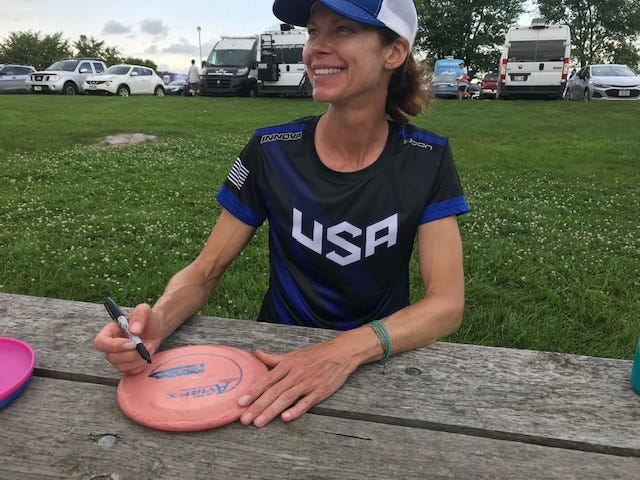
Coming back to her home roots for the tour has been good, Korver said, as an interview with a reporter was interrupted when a fan asked her to sign his scratched and scarred Innova Juliana Korver Pro Aviar Golf Disc.
Korver also had time to catch up with long-time friend Jason Steffen, the person who taught her how to play disc golf. Steffen had a booth at the event in Indianola selling discs.
“I think it was the spring semester of 1992,” Steffen said, looking at Korver for agreement. “And she wasn’t bad. Actually, she was better than most. But then, she’s always been athletic and competitive.”
“But what he didn’t mention is that he was the best player in Iowa at the time,” Korver said.
More:Officials faced confusion, a chained gate during Adventureland fatal accident response, records and recordings show
More:Des Moines developers eager to jump on new workforce housing funding approved by Gov. Reynolds
Korver’s second round of the tournament was canceled on Saturday right after her second throw on the first hole. Lightning in the area, and eventually tornado warnings, closed down the day early.
But after her first round, she was holding her own at seventh place in the field of 24.
Although the Pickard Park course has changed through the years as it has been expanded, updated and had some redesigns for the 2004 World Championships, Korver said the course appeared to be in excellent condition and felt very familiar.
“This course has the luxury of having so much space,” Korver said. “There are some who would try to put two full courses out here, rather than one.”
Korver said that being back on the course for her first round on Friday felt “emotionally surreal and lots of fun. I have a lot of memories here and my 78-year-old mother was here for the game.”
It was hard for her to block out all of the emotions that came back during the round, Korver said.
“But they were hugely wonderful emotions,” she said throwing her arms out wide. “Look at all of this. It wouldn’t be here if it were for me. That’s heavy.”
Teresa Kay Albertson is a reporter for the Des Moines Register and the Indianola Record-Herald. Reach her at [email protected] or 515-284-8561.
Allen built and lost leads, but never trailed at the end of a round this weekend.
February 28, 2022 by Anthony Mikos in News with comments
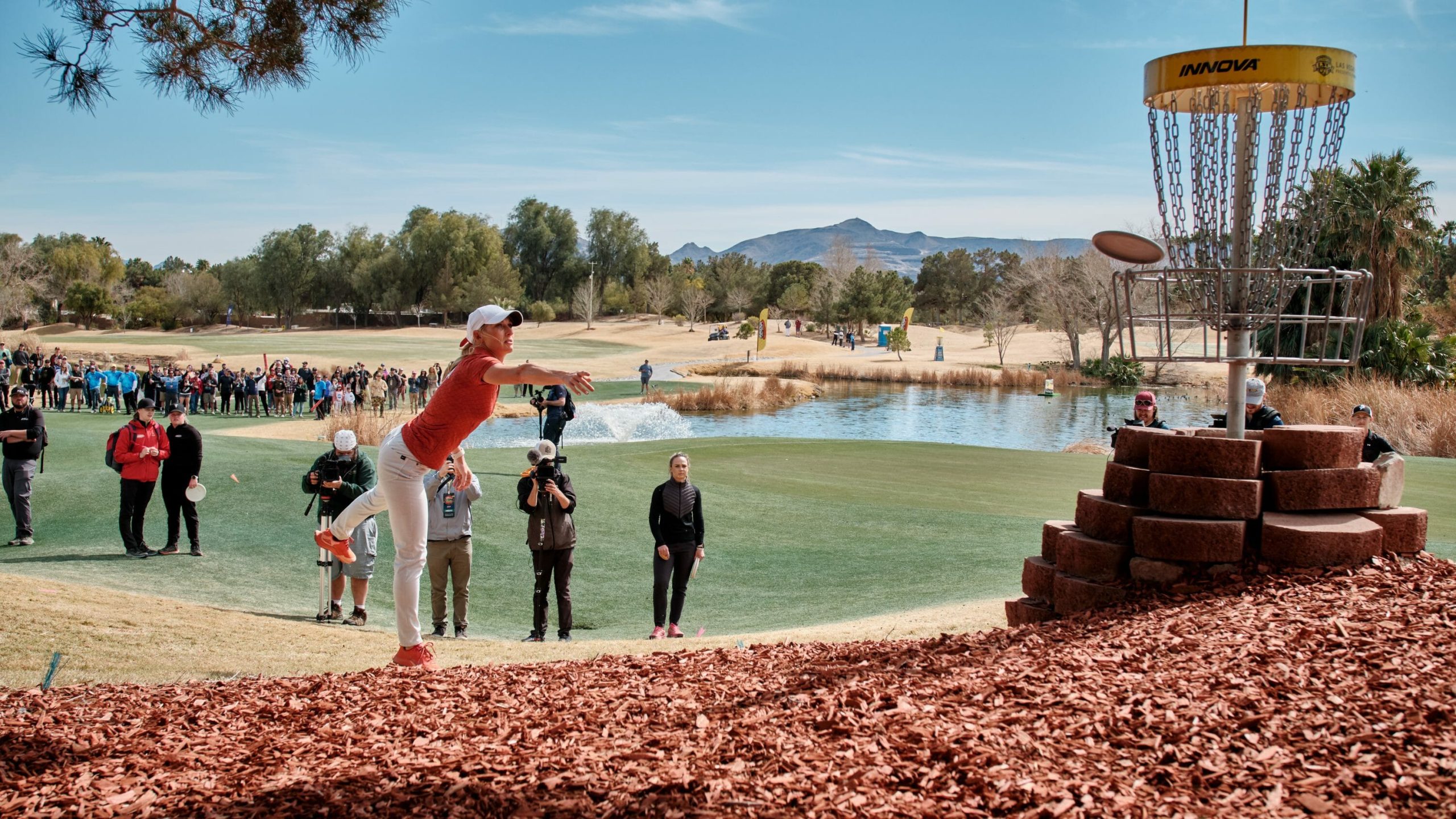
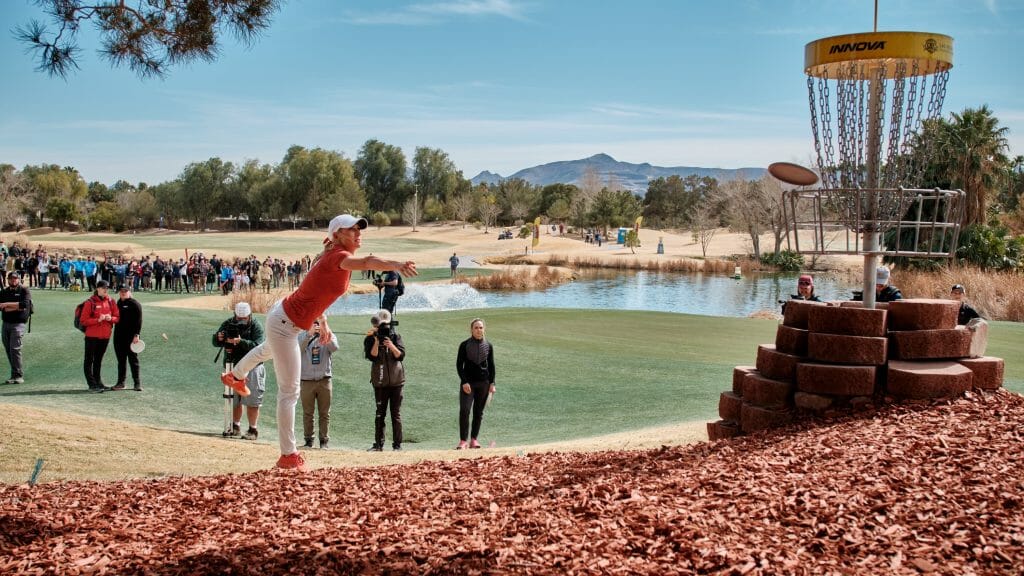
Catrina Allen puts for the win at the 2022 Las Vegas Challenge. Photo: DGPT
After four long days of disc golf at the Las Vegas Challenge, the debut tournament of the 2022 season, Catrina Allen delivered an emotional photo finish in the final round to take down the 11th Disc Golf Pro Tour win of her career.
Allen and Paige Pierce, the top two players in the US, were battling back and forth all weekend. After leading by six strokes after round two, Allen entered the fourth and final round tied with her biggest rival Pierce. She was able to jump out to an early four stroke lead after going 5-under in the front nine. The cushion wasn’t enough. Paige Pierce put together a textbook back nine performance, shooting 6-under to close the gap and tie up Allen on hole 15. The final three holes were going to determine the tournament with the intensity only rising.
Heading into hole 18, which plays as a 720 foot par five with OB nearly everywhere, the pair was still in lockstep. After two solid shots, Pierce’s upshot was under-thrown and skipped into the pond, costing her a penalty stroke. Allen, already safe on the other side of the water, was able to pitch up and tap in the birdie to secure her her first win of the season. Allen finished the round 9-under par, capping off a 30-under par weekend.
“I’m really nervous that it came down to the last hole,” Allen said. “I was just walking up to that last putt thinking of all the mornings in the gym, all the hours on the putting green, and just that I deserved it. I was really happy for myself.”
Catrina Allen was no stranger to the Innova Course. Her round two performance clocked in at 11-under par, one of the best rounds at the tournament in over 3 years. She knew, though, that this final round had to be played like any other day. “It’s hard coming back to a course that you played so well,” she said. “I was trying to just play the conditions today and play my game today instead of thinking ‘Oh I biridied this yesterday’ or ‘I eagled this the other day.’ Just play the course for what it was today, so that was really good.”
This marks Allen’s first win as a DGA-sponsored player. Archer, not arrows, as they say.
“I got some [DGA] discs on January 3rd or 4th and have just been in the field ever since,” said Allen. “I’ve enjoyed the process and the support from the DGA family and everyone at the warehouse.”
Allen won’t bask in this win, her 37th career Elite Series victory. She is already looking ahead to her tournament next week in Waco. Brazos East, a park-style course with technical lines, is nothing like the wide open desert of Las Vegas.
“I know that there are some things that I can improve on for the next week,” she said. “We’re going to get into the woods a little bit, so really make sure that the timing is good and just the same old grind. Wake up, gym, field work, and putting. Same old, same old.”
Behind Allen and Pierce, Kristin Tattar rounded out the podium, five strokes back from Pierce at 25-under on the weekend after posting her worst round of the weekend, a 957-rated 5-under par held back by five OB strokes. Despite the bumpy finish, the Estonian looks primed to have another highly successful season in the US. She was one of the best Circle 1 putters on the weekend (T-6th at 76%) and finished second at the tournament in both birdie percentage and parked percentage.
Hailey King came back from a poor opening round to finish in fourth place in her first event as an Innova-sponsored pro. She was on the green with a chance to birdie all weekend, but was plagued by out-of-bounds mistakes; she had 16 OB strokes, more than any other player in the top 10.
The final round on the Innova course at Las Vegas played as the easiest round on the weekend by miles. It was the only round of the weekend where the women averaged below par on the course at -3.63. Ella Hansen and Missy Gannon tied Catrina Allen’s hot round at 9-under, and they rode that to sixth and seventh place finishes, respectively.
Entering the final round, Eveliina Salonen was another top European name to watch, but her 3-under par performance was not enough to make the podium. After birdieing or better on four out of five holes mid round, she closed out the round shooting three bogeys in her final four holes. Putting was her kryptonite — she shot just 51% from Circle 1 on the weekend. She finished in 5th.
February 14, 2022 by Charlie Eisenhood in News, Recap with comments
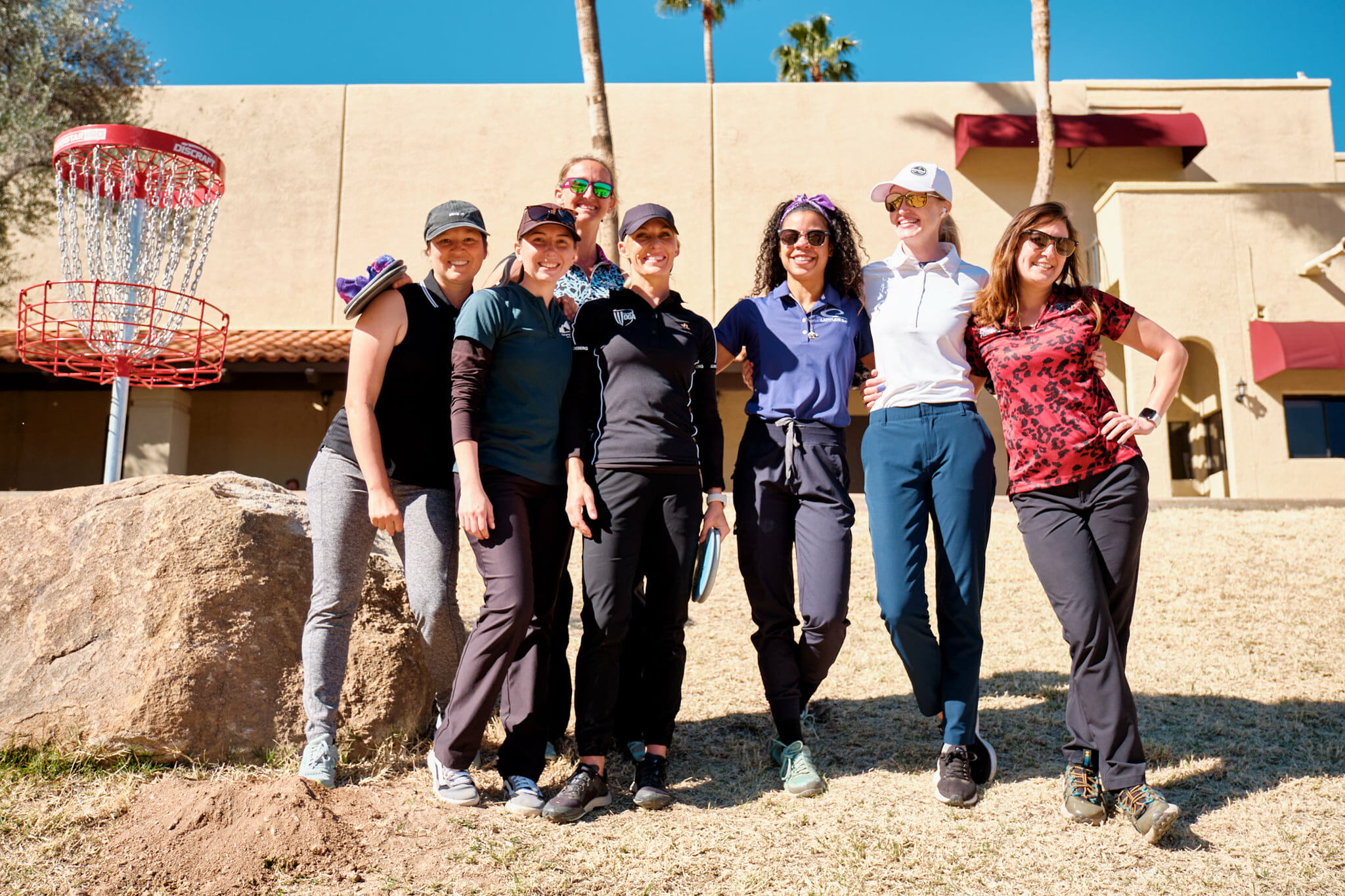
Team Catrina at the 2022 DGPT All-Star Weekend. From left: Lisa Fajkus, Deann Carey, Sarah Hokom, Catrina Allen, Rebecca Cox, Holly Finley, and Jessica Weese. Photo: DGPT
TUCSON — Who said an exhibition event couldn’t deliver high drama?
Calvin Heimburg’s final uphill pressure putt on Sunday sealed his team’s victory over Team Eagle McMahon at the 2022 Disc Golf Pro Tour All-Star Weekend just moments after McMahon buried an obstructed putt from outside Circle 2 that could have forced a playoff:
Heimburg’s one-stroke win over McMahon scored the decisive point in the All-Star contest, giving Team Calvin a 7-6 win over Team Eagle. Heimburg shot Sunday’s best singles round, a 1090-rated 13-under par. Team Eagle had been the favorite heading into the competition.
In FPO, Team Catrina stunned Team Paige 7-6, climbing out of a one point deficit in singles on Sunday. Catrina Allen’s 1015-rated 7-under par easily bested Paige Pierce’s 4-under, Sarah Hokom beat Missy Gannon, Lisa Fajkus topped Kona Panis, and Deann Carey eked by Heather Young to score enough final day points to push Team Catrina ahead. Their win was widely viewed as a big upset: before the event, more than 90% of people in an UWDG Twitter poll picked Team Paige to win.
The highlight of the weekend was a stunning 536′ ace from Nikko Locastro on Sunday that helped catapult him to a win in his matchup with Matt Orum:
No team established a large lead early in the competition. Team Eagle went up 2-1 during the Skills competition before Team Calvin tied it up during Doubles on Saturday. Team Calvin won four out of the seven matchups on Sunday to win.
Team Paige had a one point lead after the Skills competition and maintained that through Doubles. Team Catrina won four of the matchups on Saturday, lost two, and tied one.
Here’s a look at the results from each day of the action.
Friday Skills Competition Results
Distance
Paige Pierce + Kona Panis’s combined 866′ outdid Catrina Allen + Jessica Weese 830′ in the FPO distance competition.
Best Drives
Pierce: 442′ Allen: 439′ Panis: 424′ Weese: 391′
In MPO, Calvin Heimburg and Ezra Aderhold shocked Drew Gibson and Garrett Gurthie with a 1280′ to 1262′ win. Calvin’s drive, especially, was impressive. The narrow fairway with OB on both sides made it difficult for Gurthie and Gibson to maximize the distance they typically flash in such contests.
Team Catrina’s Sarah Hokom + Rebecca Cox outscored Team Paige’s Hailey King + Madison Walker 24-13 in the accuracy competition.
Team Eagle’s Kevin Jones and Nikko Locastro beat out Team Calvin’s Kyle Klein and Matt Orum 38-33 in accuracy.
Putting
Missy Gannon, Heather Young, and Ohn Scoggins dominated for Team Paige, with a 90-56 win over Team Catrina’s Holly Finley, Lisa Fajkus, and Deann Carey. Young was the top individual performer.
Team Eagle’s Eagle McMahon, Chris Dickerson, and Gannon Buhr defeated Team Calvin’s Adam Hammes, James Conrad, and Paul Ulibarri 115-93.
Coverage is available on Disc Golf Network.
Saturday Doubles Competition Results
In FPO, the teams split the points 1.5 apiece.
Team Catrina’s Allen/Carey (-8) defeat Gannon/Panis (-4)
Team Paige’s Hailey King/Ohn Scoggins (-9) defeat Cox/Hokom (-5)
Team Paige’s Young/Pierce (-9) tie Fajkus/Weese (-9)
In MPO, Team Calvin outscored Team Eagle 2-1.
Team Eagle’s McMahon/Jones (-14) tie Hammes/Klein (-14)
Team Calvin’s Heimburg/Orum (-14) tie Dickerson/Gibson (-14)
Team Calvin’s Conrad/Aderhold (-14) defeat Buhr/Locastro (-13)
Coverage is available on Disc Golf Network.
Sunday Singles Competition Results
In FPO, Team Catrina outscored Team Paige 4.5-2.5.
Catrina Allen (-7) beat Paige Pierce (-4)
Sarah Hokom (-3) beat Missy Gannon (-1)
Hailey King and Jessica Weese tied at (+1)
Lisa Fajkus (+1) beat Kona Panis (+4)
Deann Carey (+1) beat Heather Young (+2)
Rebecca Cox (-1) lost to Ohn Scoggins (-3)
Holly Finley (+9) lost to Madison Walker (+1)
FPO Singles All-Star Weekend
In MPO, Team Calvin outscored Team Eagle 4-3.
Calvin Heimburg (-13) beat Eagle McMahon (-12)
Kyle Klein (-8) beat Chris Dickerson (-2)
James Conrad (-9) beat Drew Gibson (-7)
Adam Hammes (-3) lost to Kevin Jones (-5)
Ezra Aderhold (-8) beat Gannon Buhr (-5)
Matt Orum (-6) lost to Nikko Locastro (-7)
Paul Ulibarri (-1) lost to Garrett Gurthie (-9)
MPO Singles All-Star Weekend
The 2022 Disc Golf Pro Tour starts on February 24th at the Las Vegas Challenge.
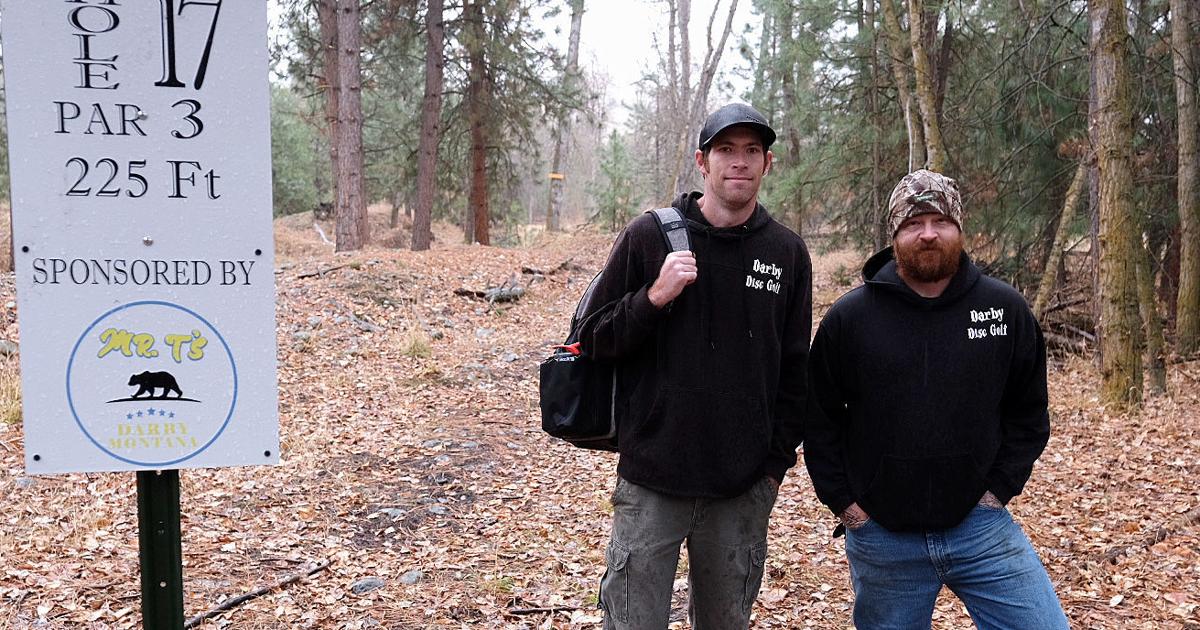
The Chain Bangers’ rules are simple at Darby’s new River Park Disc Golf Course
“Be human,” said the course’s co-founder Rick Spross. “And be sure to have fun.”
The definition of being human is also simple enough. Don’t throw your discs at those passing by. Pick up your own garbage. Be kind to others.
And don’t expect either Spross or his fellow disc golf course builder, Jeremiah Bennett, to tell you about the rules.
“We’re not going to put rules on anyone,” Spross said, with a smile.
The two young fathers are instead focused on ensuring their community has something new that will encourage kids to put down their video game controllers and get outdoors with their families and friends to enjoy the natural area in their own backyard.
The 18-hole disc golf course the pair created after maneuvering their way through the politics of local government and gaining support from many of Darby’s businesses is already catching on.
People are also reading…
On one day this past summer, Spross was surprised to find nearly 50 people out playing the course.
The idea for a disc golf course for Darby was hatched as the two men were playing other courses in Victor and Missoula.
“We thought if we could get something here that everyone could enjoy, it would save them the trip to other places,” Bennett said. “It would be nice to have a course a little closer to home. And we knew that everyone likes to play new courses so it might bring some people to town.”
After navigating a small speed bump over a misunderstanding on the impact the course would have on access to the park and receiving the go-ahead from the town council, the men went to work to clear a decade’s worth of downed branches and other debris from the new course’s fairways. They used their own lawnmowers and weed-eaters to mow down the grass. And they installed the tee-boxes and baskets that marked the two ends of a hole.
They both invested hundreds of hours in making their dream for the community come true.
“We started as being the ones doing the work and then more people got involved,” Spross said. “This wasn’t a project completed by town employees. It was all volunteers.”
Both were happily surprised early in the building process to hear chains banging (hence the name of their disc golf club) along the course as disks found their way into the chain baskets.
“People were showing up and playing as we were building it,” Bennett said. “We didn’t advertise it. They just noticed when the baskets started to appear. We’ve seen kids and their parents and older people down there. It’s been nice to see the variety of people show up and play.”
Neither had done anything quite like this before.
“We just put our heads together and what we saw as we walked through the park just came together,” Spross said. “When we were designing it, we wanted to ensure that we didn’t change anything. The bends that people find in the course are the way it was.”
The popularity of disc golf is on the rise.
“The concept is just like golf but instead of hitting a ball, you’re going to throw a disc,” Bennett said. “The only difference is it’s a lot cheaper to get started and it doesn’t cost anything to play at our course.”
Discs cost anywhere from $10 to $30. People can play the course with one disc or they can splurge and buy different size disks that serve as drivers, mid-range and putters.
“It’s just fun,” Spross said. “You don’t have to be good at it. We’re not in it for the competition. We just want to have a place where a group of people can gather, have fun, talk and still socially distance if they want.”
The Chain Banger Club has a winter league up and going. The men hope this spring when the temperatures warm that they can offer a couple of classes to students at the Darby School.
“As a kid growing up in Darby, it was hard because you didn’t really have a whole bunch of things to do,” Spross said. “It really dawned on me when I had children. Darby needs a place where kids and their family can go and do something together.”
“I really hope that it brings something positive for our community,” he said. “We want it to be something people can see and say, ‘hey, this is good for this town.’”
Darby Mayor Ruth Lendrum believes they’ve accomplished just that.
“It’s a really nice addition to our town,” Lendrum said. “I think the town feels it’s a wonderful activity for families and young people. Since the park goes right down to the river, people who go there to play disc golf can also fish or hang out on the beach.”
Lendrum was encouraged to see the two men take their idea through the public process that included a meeting packed with people in support.
“That included the previous mayor who goes down there and plays disc golf with his grandkids,” she said. “I feel like they learned so much about the political process and how to make it work. We’re a small town and we’re always looking for people to get involved in politics.”
But Lendrum said she’s most proud of them for all their hard work and focus on a project that they felt was important to build for their children.
“Who can doubt the ability to achieve by two young fathers who want to do something for their children?” she said.
Shape your shot to get the most out of your discs.
March 22, 2022 by Steve Andrews in Instruction, Opinion with comments
Catrina Allen is a deadly hyzerflip thrower. Photo: DGPT.
When I first started playing, my friend Cyrus told me that I needed to throw hyzerflips. I was mesmerized by his stories of these legendary shots that would fly dead straight with easy distance and great control. It was like hearing about a unicorn. Unfortunately, I had no clue what he was talking about. I tried throwing them like he instructed, but I just got simple hyzers or shots that rolled over and crashed. I just assumed I couldn’t throw hyzerflips – whatever they were – and moved on.
A year later, I was doing field work and threw an understable Hatchet. It flipped up and went dead straight past my distance drivers. Cyrus had been right; I saw the unicorn. However, while I could get them to work in the field, I was still uncomfortable trying to throw hyzerflips on the course. Manipulating a less stable disc to fly straight seemed riskier than just throwing an overstable disc that would overcome my swing flaws and do the same thing every time.
Maybe you feel the same way. I understand that sentiment, but I pushed through and now hyzerflips are a key part of my game. They are extremely useful – especially for lower-power players. They are also the best way to learn to shape shots and control the full flight of your disc.
So, what are hyzerflips and how can you add them to your game?
The Basics
The simplest explanation of a hyzerflip is an understable disc thrown on a hyzer angle. Thrown righthand backhand (RHBH), the hyzer release overcomes an understable disc’s tendency to turn to the right; instead, the disc will rotate to a flat position (“flip to flat”) and then fly straight. If the disc is very understable, the disc will drift to the right towards the end of its flight. This is sometimes called a “hyzerflip to turn” shot on disc golf commentary.
Hyzerflips thrown with more stable discs will usually hold a straight flight and then smoothly fade out to the left as they lose speed. You are getting a full flight and using the understability of the disc to your benefit, so throwing smooth, rather than hard, is the goal.
The key to hyzerflips is balancing these three factors: disc stability, degree of hyzer angle, and arm speed. A disc that is too overstable for your arm speed will hyzer out and never flip up. A very understable disc thrown with too little hyzer or too much power will flip all the way over and roll. You need to balance the disc’s understability with the correct amount of power and angle. This may sound complicated, but it is much easier in practice.
First, you need to take a good look at your game – can you effectively hit a consistent hyzer angle? If so, then the rest of the process will be much easier. However, if you always throw on anhyzer (perhaps because you have been trying to throw discs that are too overstable) then you may need to work on being able to throw a reliable hyzer. Once that is in your arsenal, you are ready to work on hyzerflips.
Get your most understable disc and throw it on hyzer. Start slowly and see whether it will flip to flat. Try throwing at different speeds and with more and less hyzer. There is a point where the correct combination of angle and power will get the flight you want. Also experiment with your footwork because a standstill hyzer flip is a powerful weapon. You may be shocked at how far and straight you can throw a flippy fairway or mid from a standstill. A shot like this can revolutionize your play in the woods.
You will need to experiment with being able to reliably change these three factors to get the flights you want. The easiest thing to change is, of course, your disc selection. If a disc isn’t flipping to flat, then just get a more understable disc. This is not always the solution, however, because very understable discs are also usually extremely sensitive to angle and power. It is easy for them to flip over too much and produce a confidence-crushing roller.
It is natural to find that you are more comfortable changing either your angle or your speed. The best players can do both, but sometimes trying to throw harder ruins your timing or you lose velocity when you try to add more hyzer angle. Modifying either angle or speed can work, but see whether you are more comfortable changing one factor from throw to throw. The goal is to find an angle and speed you can throw consistently.
Once you get the feeling for it, move towards hyzerflipping more stable discs. You will reach a point where you can’t generate enough pace to get the disc to flip to flat on even a slight hyzer angle. Once you find this stability threshold where your discs stay on hyzer without flipping up, you will have discovered which of your discs will hyzerflip and can start experimenting with angles and power to see how you can change the flights.
If you combine variations in stability, power, and angle, you can throw a huge variety of shots. If you want to throw it harder, just add more hyzer. If you have to throw it softer to hit a gap, choose a more understable disc and throw it slightly flatter. If you increase the hyzer or throw it slower, the disc will turn later or not at all; if you increase the speed or throw it flatter, it will turn more and start turning earlier. Once you get the hang for the kinds of adjustments you feel comfortable making, you will discover that you can get your discs to turn or fade at different points in their flight.
Using Hyzerflips on the Course
Perhaps the best use of the hyzerflip is to be able to hit tight lines and keep the disc moving straight — or even get it to turn right at the end of its flight. This adds another tool to go alongside your forehands and turnovers and is especially useful in the woods. Keeping an overstable disc flying straight requires throwing it very hard, which can make hitting tight lines difficult. The hyzerflip gives you more accuracy with less power and usually provides a softer landing.
Turnovers often ride a consistent arc through their flight. One of the great advantages of a hyzerflip is being able to blend the straight portion of the flight with late turn or fade. This is an important part of great shotmaking. One of the great skills of the true artists of disc flight like Dave Feldberg or Nikko Locastro is the ability to control exactly when a disc will change direction. One way to do that is by dialing in your hyzerflips.
The hyzerflip is also a great way for lower power players to get extra distance. Instead of flexing an overstable disc that wants to get to the ground, the hyzerflip uses an understable disc’s ability to glide and stay in the air to your advantage. The slow flip and ride of a hyzerflip chews up distance and reduces the tendency of these discs to flip over – by the time the disc has flipped to flat, much of the initial velocity is gone, so the disc’s turn will be more mellow and longer lasting than if it had been thrown flat. While a giant sky anhyzer has more maximum distance potential, that shot requires a lot more air clearance to throw. The hyzerflip adds extra distance while also remaining very accurate.
You may find that your arm speed only allows you to throw hyzerflips with understable fairways and mids. That’s fine. I actually find that my hyzerflip Roadrunners will often land out with my distance drivers. However, if you have the arm speed for it, a hyzerflip is a great way to throw understable or beat-in drivers. Creating a hyzerflip driver is one advantage of cycling your discs. You can throw them hard with hyzer, have them flip up, and then get a nice gentle fade when their remaining low speed stability kicks in at the end of the flight.
Hyzerflips also help you build a more versatile forehand. Perhaps unsurprisingly for a player who honed his game in the woods of North Carolina, Jeremy Koling is a great forehand player who can work angles and hit lots of lines. His game is not built around a power forehand like Eagle McMahon’s; instead, Koling often hyzerflips understable discs which allows him to throw incredibly tight lines:
Koling
All the lessons of learning the backhand hyzerflip can also be used to develop a hyzerflip forehand. As you incorporate this shot into your game, make sure to experiment with a standstill forehand with an understable fairway. It is a great weapon when you have awkward footing or need to hit a tight gap.
Cautions
For all their utility, there is more to worry about when throwing a hyzerflip rather than a simple flat shot. You can throw a Firebird and always have a good idea of how it will fly; hyzerflipping a Leopard brings in more variables. You need to hit the right angle and speed to get the shot you want. Therefore, dialing in your discs in field work is important. Once you have found discs you can trust and have a good feeling for how to throw them, however, hyzerflips can be very reliable.
Hyzerflips can also be harder to throw in the wind. Since it is a shot that changes its angle as it flies, wind can make the flight unpredictable. A headwind or tailwind will change the amount of angle and speed you need to get the flight you want. Also, since a hyzerflip comes out on a hyzer angle, crosswinds can prevent the disc from flipping flat or shove it offline. Don’t run away from hyzerflips in light wind but use your field work to figure out which discs you can trust in tougher conditions. If it is really howling, I would keep the hyzerflip in the bullpen and throw other shots instead.
***
Hyzerflips allow you to take more ownership of your shotmaking. It is a way to move away from throwing a shot that just has one shape – like a hyzer backhand that moves consistently to the left – and lets you decide how and when the disc will move. There is nothing better for your confidence than being able to dial up different shot shapes on command. It is also a shot that is a good fit for many of the discs that lower power players are already using. It will allow you to get more out of your Jades, Leopards, and Comets.
Even if you are reluctant to throw hyzerflips in competition, try them in the field. It is a great way to test whether you can consistently hit the angles you want and change speeds reliably. I bet once you have thrown some, you won’t be able to resist trying them out when it counts. I think your rating will thank you.
OTTUMWA — Join in the fun as the Ottumwa Symphony Orchestra presents “Divas Who Dish” at Bridge View Center on Saturday, April 2 at 6 p.m.
Some of Ottumwa’s best lady cooks will offer samples of their favorite recipes. Enjoy your fill of their delicacies while participating in the Silent and Live Auction, a “Heads or Tails” game and the ever popular “Wine Pull.” A cash bar will also be available.
Divas who will serve you to date include Balba Chiapa, Mandy Walker, Ashleigh Vivian, Cherielynn Westrich, Brenda Anderson, Melissa Childs, Addy and Ellie Yates, Sandra Pope, Betty Ramirez, Sandra Thorne, Andrea Edge, Amy Nossaman and Kaitlyn Noal.
The Divas will be judged in Pre-Dining, Entrée and Dessert categories. The team of judges for the evening include Mark Fisher, Heather Nelson and Taylor Thornsberry. Attendees will select the People’s Choice award.
Items for the Silent Auction will be open for bidding upon arrival (be sure to check out the Blue Line Drawing). Auction items are available now for viewing at the Symphony website: ottumwasymphonyrochestra.net. Some items will be featured on the Symphony’s Facebook. All bidding will occur the evening of the event.
Live Auction items include a chef’s table for eight at Bridge View Center; a round of golf with five-time Ottumwa City Champion Dusty Stewart at the beautiful grounds of The Club. Dusty won Ottumwa city titles in 2004, 2005, 2012, 2020 and 2021. The Club is sponsoring carts and green fees at no cost for a group of up to three (date and time determined by winner bidder); and Wine among the Roses, where you enjoy a summer or fall evening among the roses. You and up to nine of your friends will be treated to fantastic wine tasting and food pairing in a gorgeous garden setting, sponsored by the Ottumwa Symphony Orchestra Guild.
Also included in the Live Auction will be “Food, Fun, and Fish if You Wish” for 12 that includes BBQ, fishing and kayaking by Patty and Alan Babb, sponsored by North Hy-Vee. A disc golf package will be auctioned off for a party of four (date and time determined by the winning bidder), and a disc golf basket, bag, four disc golf discs and a two hour lesson from seven-time Iowa State Champion and Iowa Disc Hall of Famer Bob Kramer, who has also qualified for the 2022 Disc Golf National Tournament.
Advance tickets are $20 and are available from any of the Divas at Bridge View Center or online at ottumwasymphonyorchestra.net. Tickets at the door are $25. For more information or questions, contact Cara Galloway at [email protected] or 515-509-3745 or Barb Sasseen at [email protected] or 641-777-5604.
All profits from the “Divas Who Dish” event go to support activities of the Ottumwa Symphony Orchestra, proudly serving Ottumwa by presenting seven concerts annually.
A disc golf course will soon be joining entertainment and activity options in the city of Washington Court House.
As previously reported, local Jason Stritenberger began the initiative for the local course and even started his own disc golf supply shop in downtown Washington C.H. at 149 S. Fayette St.
According to www.discgolf.com/, “Disc golf is similar to traditional golf; however, instead of using golf clubs and balls aiming for a hole, disc golf players use disc golf discs and aim for a disc golf basket which is a pole extending up from the ground with chains and a basket where the disc lands. The object of the game is to complete each hole in the fewest number of throws, starting from a tee area and finishing with the disc coming to rest in the basket.”
There are several different types of disc golf courses.
The website further explains, “Generally, a course is made up of 9 or 18 holes. Players start at hole one and complete the course in order, playing through to the last hole. The player with the lowest total cumulative throws wins. Disc golf differs from traditional golf in important ways. Disc golf courses can use a wide variety of terrain. Often times, land not suitable for other park activities or development is the perfect terrain for a disc golf course.”
The local course is planned to be located off the walking path that connects Washington Cemetery to Chrisman Park — behind the Waste Water Treatment Plant.
According to Stritenberger, the local one will be an 18-hole course. A gravel parking lot will be created behind the water treatment plant, and hole one will start in that area. The course will then loop around and end back near the starting point.
“It’s a good mix of hole design,” said Stritenberger. “I’m very excited. Not only will it be good for people that already play disc golf, but hopefully it will get a lot of locals to find out about it and what it is, try it out.”
The course will be called, “Soldiers’ Row Disc Golf Course.” Stritenberger explained it is named after Soldiers’ Row in Washington Cemetery.
The course was funded by local sponsors, including the city. Stritenberger also worked with the city to get permission for the course to be built on public land, making it available for use at no cost to the public.
While the funds for the course have been raised, he explained volunteers will be building the course as the weather allows.
To follow news about the course, follow the Facebook page, “Soldiers’ Row DGC.”
Reach journalist Jennifer Woods at 740-313-0355.
Disc golf is becoming an easier activity for the community to enjoy as access is increasing.
18-hole course to be called ‘Soldiers’ Row Disc Golf Course’





:format(webp):no_upscale()/cdn.vox-cdn.com/uploads/chorus_asset/file/22671605/unnamed1.jpeg)
:format(webp):no_upscale()/cdn.vox-cdn.com/uploads/chorus_asset/file/22671685/jennifer_delaney_1.jpeg)
:format(webp):no_upscale()/cdn.vox-cdn.com/uploads/chorus_asset/file/22671612/AquinasVolleyball.jpeg)
:format(webp):no_upscale()/cdn.vox-cdn.com/uploads/chorus_asset/file/22671614/Mcbeth_1.jpeg)